Get Free Shipping on orders over $79
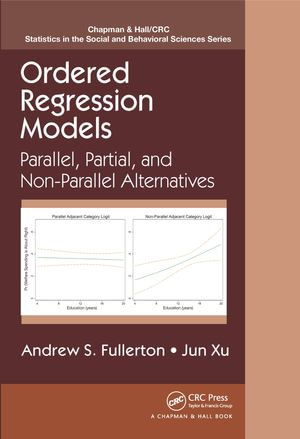
Ordered Regression Models : Parallel, Partial, and Non-Parallel Alternatives - Andrew Fullerton

Ordered Regression Models

Parallel, Partial, and Non-Parallel Alternatives

By: Andrew Fullerton, Jun Xu

eText | 21 April 2016 | Edition Number 1

At a Glance

eText


$107.79

or 4 interest-free payments of $26.95 with

 or 

Instant online reading in your Booktopia eTextbook Library *

Why choose an eTextbook?

Instant Access *

Purchase and read your book immediately

Read Aloud

Listen and follow along as Bookshelf reads to you

Study Tools

Built-in study tools like highlights and more

* eTextbooks are not downloadable to your eReader or an app and can be accessed via web browsers only. You must be connected to the internet and have no technical issues with your device or browser that could prevent the eTextbook from operating.

Ordered Regression Models: Parallel, Partial, and Non-Parallel Alternatives presents regression models for ordinal outcomes, which are variables that have ordered categories but unknown spacing between the categories. The book provides comprehensive coverage of the three major classes of ordered regression models (cumulative, stage, and adjacent) as well as variations based on the application of the parallel regression assumption.

The authors first introduce the three "parallel" ordered regression models before covering unconstrained partial, constrained partial, and nonparallel models. They then review existing tests for the parallel regression assumption, propose new variations of several tests, and discuss important practical concerns related to tests of the parallel regression assumption. The book also describes extensions of ordered regression models, including heterogeneous choice models, multilevel ordered models, and the Bayesian approach to ordered regression models. Some chapters include brief examples using Stata and R.

This book offers a conceptual framework for understanding ordered regression models based on the probability of interest and the application of the parallel regression assumption. It demonstrates the usefulness of numerous modeling alternatives, showing you how to select the most appropriate model given the type of ordinal outcome and restrictiveness of the parallel assumption for each variable.
Web Resource
More detailed examples are available on a supplementary website. The site also contains JAGS, R, and Stata codes to estimate the models along with syntax to reproduce the results.

on
Desktop
Tablet
Mobile

Other Editions and Formats

Paperback

Published: 18th December 2020

Available for Backorder. We will order this from our supplier however there isn't a current ETA.

More in Probability & Statistics