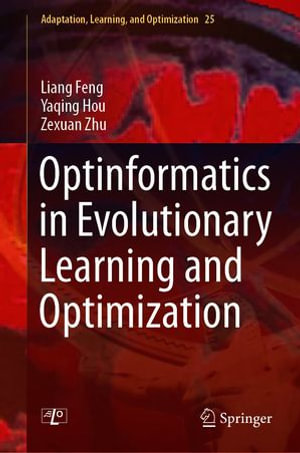
This book provides readers the recent algorithmic advances towards realizing the notion of optinformatics in evolutionary learning and optimization. The book also provides readers a variety of practical applications, including inter-domain learning in vehicle route planning, data-driven techniques for feature engineering in automated machine learning, as well as evolutionary transfer reinforcement learning. Through reading this book, the readers will understand the concept of optinformatics, recent research progresses in this direction, as well as particular algorithm designs and application of optinformatics.
Evolutionary algorithms (EAs) are adaptive search approaches that take inspiration from the principles of natural selection and genetics. Due to their efficacy of global search and ease of usage, EAs have been widely deployed to address complex optimization problems occurring in a plethora of real-world domains, including image processing, automation of machine learning, neural architecture search, urban logistics planning, etc. Despite the success enjoyed by EAs, it is worth noting that most existing EA optimizers conduct the evolutionary search process from scratch, ignoring the data that may have been accumulated from different problems solved in the past. However, today, it is well established that real-world problems seldom exist in isolation, such that harnessing the available data from related problems could yield useful information for more efficient problem-solving. Therefore, in recent years, there is an increasing research trend in conducting knowledge learning and data processing along the course of an optimization process, with the goal of achieving accelerated search in conjunction with better solution quality. To this end, the term optinformatics has been coined in the literature as the incorporation of information processing and data mining (i.e., informatics) techniques into the optimization process.
The primary market of this book is researchers from both academia and industry, who are working on computational intelligence methods and their applications. This book is also written to be used as a textbook for a postgraduate course in computational intelligence emphasizing methodologies at the intersection of optimization and machine learning.