Get Free Shipping on orders over $79
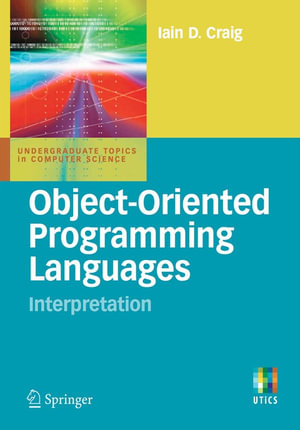
Object-Oriented Programming Languages : Interpretation - Iain D. Craig

Object-Oriented Programming Languages

Interpretation

By: Iain D. Craig

eText | 16 July 2007

At a Glance

eText


$59.99

or 4 interest-free payments of $15.00 with

 or 

Instant online reading in your Booktopia eTextbook Library *

Why choose an eTextbook?

Instant Access *

Purchase and read your book immediately

Read Aloud

Listen and follow along as Bookshelf reads to you

Study Tools

Built-in study tools like highlights and more

* eTextbooks are not downloadable to your eReader or an app and can be accessed via web browsers only. You must be connected to the internet and have no technical issues with your device or browser that could prevent the eTextbook from operating.
1.1 Introduction Object-oriented programming has opened a great many perspectives on the concept of software and has been hailed as part of the solution to the so-called "software crisis". It has given the possibility that software components can be constructedandreusedwithconsiderablymorecredibility.Therearenowmany case studies in which the reuse of object-oriented components has been made and analysed. Object-oriented programming relates the programming activity to that of modelling or simulation; objects are identi?ed by a correspondence with the objects found in the application area of the program and are used to model those domain operations. Object-oriented programming also opens the prospect of more ?exible software that is able to respond dynamically to the needs of the application at runtime. It is very easy to think that object-oriented programming can be performed in only one way. The prevalence of C++ and Java suggests that they are the onlywaytoapproachtheproblemofwhatanobject-orientedprogrammingl- guage should look like. There are many approaches to this way of programming andC++andJavaexemplifyjustoneofthesedi?erentapproaches.Indeed,the wayinwhichtheconceptoftheobjectisinterpreteddi?ersbetweenapproaches and between languages. The two main approaches found in object-oriented programming languages are, respectively, class-based and prototype-based languages. Class-based l- guages are exempli?ed by Smalltalk [34], C++ [75, 74] and Java [47]. This 2 1. Introduction approach is based upon the identi?cation of common properties of objects and their description in terms of a de?nitional structure called a class. The objects manipulated by class-based programs are the result of instantiating classes.
on
Desktop
Tablet
Mobile

More in Computer Programming & Software Development

The End of Leadership - Barbara Kellerman

eBOOK