Get Free Shipping on orders over $79
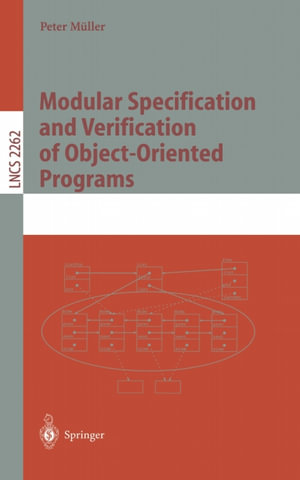
Modular Specification and Verification of Object-Oriented Programs - Peter Müller

Modular Specification and Verification of Object-Oriented Programs

By: Peter Müller

eText | 31 July 2003

At a Glance

eText


$84.99

or 4 interest-free payments of $21.25 with

 or 

Instant online reading in your Booktopia eTextbook Library *

Why choose an eTextbook?

Instant Access *

Purchase and read your book immediately

Read Aloud

Listen and follow along as Bookshelf reads to you

Study Tools

Built-in study tools like highlights and more

* eTextbooks are not downloadable to your eReader or an app and can be accessed via web browsers only. You must be connected to the internet and have no technical issues with your device or browser that could prevent the eTextbook from operating.
Software systems play an increasingly important role in modern societies. Smart cards for personal identi?cation, e-banking, software-controlled me- cal tools, airbags in cars, and autopilots for aircraft control are only some examples that illustrate how everyday life depends on the good behavior of software. Consequently, techniques and methods for the development of hi- quality, dependable software systems are a central research topic in computer science. A fundamental approach to this area is to use formal speci?cation and veri?cation. Speci?cation languages allow one to describe the crucial p- perties of software systems in an abstract, mathematically precise, and implementation-independent way. By formal veri?cation, one can then prove that an implementation really has the desired, speci?ed properties. Although this formal methods approach has been a research topic for more than 30 years, its practical success is still restricted to domains in which devel- ment costs are of minor importance. Two aspects are crucial to widen the application area of formal methods: - Formal speci?cation techniques have to be smoothly integrated into the software and program development process. - The techniques have to be applicable to reusable software components. This way, the quality gain can be exploited for more than one system, thereby justifying the higher development costs. Starting from these considerations, Peter Muller ¨ has developed new te- niques for the formal speci?cation and veri?cation of object-oriented so- ware. The speci?cation techniques are declarative and implementati- independent. They can be used for object-oriented design and programming.
on
Desktop
Tablet
Mobile

More in Computer Programming & Software Development

The End of Leadership - Barbara Kellerman

eBOOK