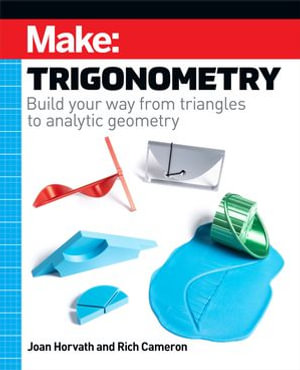
Trigonometry has 2000-year-old roots in everyday useful endeavors, like finding the size of an object too big or far away to measure directly, or navigating from Point A to Point B. However, it is often taught very theoretically, with an emphasis on abstractions. Make: Trigonometry uses 3D printable models and readily-available physical objects like wire and cardboard tubes to develop intuition about concepts in trigonometry and basic analytic geometry. Readers will imagine the thought process of the people who invented these mathematical concepts, and can try out "math experiments" to see for themselves how ingenious ancient navigators and surveyors really were.
The analytic geometry part of the book links equations to many of these intuitive concepts, which we explore through in-depth explanations of manipulative models of conic sections. This book is aimed at high school students who might be in Algebra II or Pre-Calculus. It shows the geometrical and practical sides of these topics that otherwise can drown in their own algebra.
Make: Trigonometry builds on the basics of the authors' earlier book, Make: Geometry, and is intended as a bridge from that book to their Make: Calculus book. The user can read this book and understand the concepts from the photographs of 3D printable models alone. However, since many models are puzzle-like, we encourage the reader to print the models on any consumer-grade filament based 3D printer. The models are available for download in a freely-available open source repository. They were created in the free program OpenSCAD, and can be 3D printed or modified by the student in OpenSCAD to learn a little coding along the way.