Codex can write correct code and still do the wrong job.
The goal may be misunderstood. Authority may be exceeded. Every automated test may pass while the real business outcome fails. Source code may be finished, yet a report may quietly turn that into "deployed" or "live."
The problem is rarely a lack of clever prompt wording. It is usually a failure to define the outcome, constraints, context, evidence, and final human responsibility before execution begins.
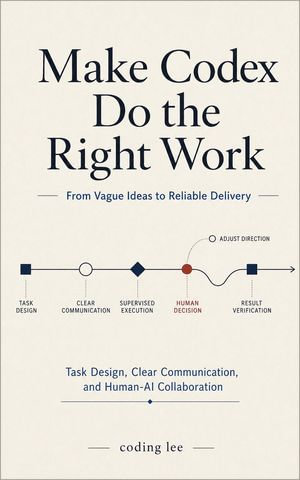
Make Codex Do the Right Work is not a prompt collection or a version-specific button manual. Drawing on six projects personally developed or operated by the author—including a game, a web tool, desktop software, a platform plugin, a hosted system, and an ecommerce operation—it presents a reusable method for serious human-AI collaboration.
You will learn how to:
• turn a wish into an executable task contract;
• separate login state, permissions, and actual authority;
• reduce complex work to the smallest useful vertical slice;
• place checkpoints where drift can be caught early;
• distinguish code-complete, test-complete, deployed, and business-complete;
• require evidence, limitations, and unfinished work instead of confident success language;
• convert each failure into a durable rule for the next project.
The appendices include ready-to-use templates for task contracts, project kickoff prompts, requirement clarification, authority matrices, progress checks, drift correction, layered completion reports, and pre-release human approval.
This book is for people using AI coding agents to build products, operate businesses, or manage technical delivery. The essential skill is not making AI do more. It is designing the conditions in which AI can do the right work—and proving that it did.