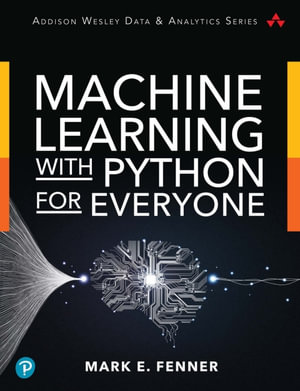
Machine Learning with Python for Everyone will help you master the processes, patterns, and strategies you need to build effective learning systems, even if you're an absolute beginner. If you can write some Python code, this book is for you, no matter how little college-level math you know. Principal instructor Mark E. Fenner relies on plain-English stories, pictures, and Python examples to communicate the ideas of machine learning.
Mark begins by discussing machine learning and what it can do; introducing key mathematical and computational topics in an approachable manner; and walking you through the first steps in building, training, and evaluating learning systems. Step by step, you'll fill out the components of a practical learning system, broaden your toolbox, and explore some of the field's most sophisticated and exciting techniques.
Whether you're a student, analyst, scientist, or hobbyist, this guide's insights will be applicable to every learning system you ever build or use.
Learn to:
- Understand machine learning algorithms, models, and core machine learning concepts.
- Classify examples with classifiers, and quantify examples with regressors.
- Realistically assess the performance of machine learning systems.
- Use feature engineering to smooth rough data into useful forms.
- Chain multiple components into one system and tune its performance.
- Apply machine learning techniques to images and text.
- Connect the core concepts to neural networks and graphical models.
- Leverage the Python scikit-learn library and other powerful tools.
Additional Benefits: Register your book for convenient access to downloads, updates, and/or corrections as they become available. See inside book for details.