Get Free Shipping on orders over $79
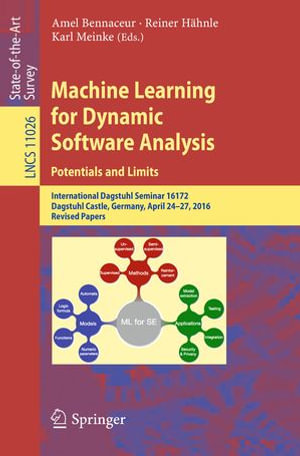
Machine Learning for Dynamic Software Analysis: Potentials and Limits : International Dagstuhl Seminar 16172, Dagstuhl Castle, Germany, April 24-27, 2016, Revised Papers - Amel Bennaceur

Machine Learning for Dynamic Software Analysis: Potentials and Limits

International Dagstuhl Seminar 16172, Dagstuhl Castle, Germany, April 24-27, 2016, Revised Papers

By: Amel Bennaceur (Editor), Reiner Hähnle (Editor), Karl Meinke (Editor)

eText | 20 July 2018

At a Glance

eText


$89.00

or 4 interest-free payments of $22.25 with

 or 

Instant online reading in your Booktopia eTextbook Library *

Why choose an eTextbook?

Instant Access *

Purchase and read your book immediately

Read Aloud

Listen and follow along as Bookshelf reads to you

Study Tools

Built-in study tools like highlights and more

* eTextbooks are not downloadable to your eReader or an app and can be accessed via web browsers only. You must be connected to the internet and have no technical issues with your device or browser that could prevent the eTextbook from operating.

Machine learning of software artefacts is an emerging area of interaction between the machine learning and software analysis communities. Increased productivity in software engineering relies on the creation of new adaptive, scalable tools that can analyse large and continuously changing software systems. These require new software analysis techniques based on machine learning, such as learning-based software testing, invariant generation or code synthesis. Machine learning is a powerful paradigm that provides novel approaches to automating the generation of models and other essential software artifacts. This volume originates from a Dagstuhl Seminar entitled "Machine Learning for Dynamic Software Analysis: Potentials and Limits" held in April 2016. The seminar focused on fostering a spirit of collaboration in order to share insights and to expand and strengthen the cross-fertilisation between the machine learning and software analysis communities. The book provides an overview of the machine learning techniques that can be used for software analysis and presents example applications of their use. Besides an introductory chapter, the book is structured into three parts: testing and learning, extension of automata learning, and integrative approaches.

on
Desktop
Tablet
Mobile

More in Software Engineering

The End of Leadership - Barbara Kellerman

eBOOK

The Debugging Handbook - Johannes Kuhlmann

eBOOK

RRP $67.55

$54.99

19%
OFF
API Management with Bruno - Lyria Tharax

eBOOK

Essential n8n Playbook - Leandro Calado

eBOOK