

Get Free Shipping on orders over $79
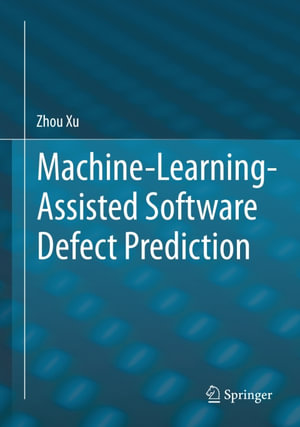
Machine-Learning-Assisted Software Defect Prediction - Zhou Xu

Machine-Learning-Assisted Software Defect Prediction

By: Zhou Xu

eText | 19 November 2025

At a Glance

eText


$329.00

or 4 interest-free payments of $82.25 with

 or 

Instant online reading in your Booktopia eTextbook Library *

Why choose an eTextbook?

Instant Access *

Purchase and read your book immediately

Read Aloud

Listen and follow along as Bookshelf reads to you

Study Tools

Built-in study tools like highlights and more

* eTextbooks are not downloadable to your eReader or an app and can be accessed via web browsers only. You must be connected to the internet and have no technical issues with your device or browser that could prevent the eTextbook from operating.
This book focuses on software defect prediction (SDP) in order to avoid threats related to quality, reliability and safety. It details advanced machine/deep learning technologies to discuss strategies for identifying and preventing such issues, and introduces innovative approaches to address feature irrelevance and redundancy, data imbalance in defect data, selection of representative module subsets for cross-version defect prediction, and managing data distribution variances in cross-project defect prediction. The book is organized into eight chapters, systematically covering various aspects of software defect prediction.  First, chapter 1 "Introduction" explains the socio-economic significance and importance of software defect prediction. Next, chapter 2 "Literature Review" reviews and analyzes current technologies and their applications in defect prediction. Then chapter 3 "Feature Learning" discusses how to extract effective features from software engineering data using machine learning techniques. While chapter 4 "Handling Class Imbalance" introduces strategies to address the class imbalance in software defect data, chapter 5 "Cross-Version Defect Prediction" analyzes the application of historical version data to enhance the accuracy of prediction models. Subsequently, chapter 6 "Cross-Project Defect Prediction" discusses how to mitigate data discrepancies between projects through transfer learning, and chapter 7 "Effort-Aware Defect Prediction" delves into new technologies to rank software modules based on the defect density. Eventually, chapter 8 "Conclusion and Future Trends" summarizes the book and outlines future research directions. The book mainly targets academic researchers and graduate students, particularly those focusing on the intersection of software engineering and machine learning. It is also intended for software engineers and data scientists working on enhancing the quality and safety of software.
on
Desktop
Tablet
Mobile

More in Artificial Intelligence

AI-Powered Search - Trey Grainger

eBOOK

HBR Guide to Generative AI for Managers : HBR Guide - Elisa Farri

eBOOK

AI : The End of Human Race - Alex Wood

eBOOK