Get Free Shipping on orders over $79
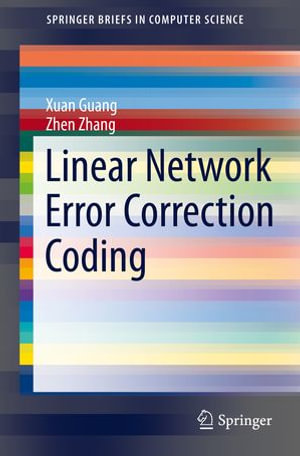
Linear Network Error Correction Coding : SpringerBriefs in Computer Science - Xuan Guang

Linear Network Error Correction Coding

By: Xuan Guang, Zhen Zhang

eText | 21 March 2014

At a Glance

eText


$84.99

or 4 interest-free payments of $21.25 with

 or 

Instant online reading in your Booktopia eTextbook Library *

Why choose an eTextbook?

Instant Access *

Purchase and read your book immediately

Read Aloud

Listen and follow along as Bookshelf reads to you

Study Tools

Built-in study tools like highlights and more

* eTextbooks are not downloadable to your eReader or an app and can be accessed via web browsers only. You must be connected to the internet and have no technical issues with your device or browser that could prevent the eTextbook from operating.

There are two main approaches in the theory of network error correction coding. In this SpringerBrief, the authors summarize some of the most important contributions following the classic approach, which represents messages by sequences similar to algebraic coding, and also briefly discuss the main results following the other approach, that uses the theory of rank metric codes for network error correction of representing messages by subspaces. This book starts by establishing the basic linear network error correction (LNEC) model and then characterizes two equivalent descriptions. Distances and weights are defined in order to characterize the discrepancy of these two vectors and to measure the seriousness of errors. Similar to classical error-correcting codes, the authors also apply the minimum distance decoding principle to LNEC codes at each sink node, but use distinct distances. For this decoding principle, it is shown that the minimum distance of a LNEC code at each sink node can fully characterize its error-detecting, error-correcting and erasure-error-correcting capabilities with respect to the sink node. In addition, some important and useful coding bounds in classical coding theory are generalized to linear network error correction coding, including the Hamming bound, the Gilbert-Varshamov bound and the Singleton bound. Several constructive algorithms of LNEC codes are presented, particularly for LNEC MDS codes, along with an analysis of their performance. Random linear network error correction coding is feasible for noncoherent networks with errors. Its performance is investigated by estimating upper bounds on some failure probabilities by analyzing the information transmission and error correction. Finally, the basic theory of subspace codes is introduced including the encoding and decoding principle as well as the channel model, the bounds on subspace codes, code construction and decoding algorithms.

on
Desktop
Tablet
Mobile

More in Computer Science

Amazon.com : Get Big Fast - Robert Spector

eBOOK

AI-Powered Search - Trey Grainger

eBOOK

Tissue Proteomics : Methods and Protocols - Taufika Islam Williams

eBOOK

RRP $369.00

$332.99

10%
OFF