Get Free Shipping on orders over $79
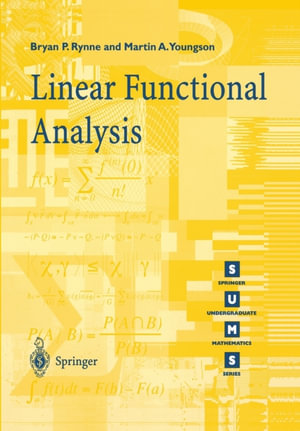
Linear Functional Analysis - Bryan Rynne

Linear Functional Analysis

By: Bryan Rynne, M.A. Youngson

eText | 14 March 2013

At a Glance

eText


$129.00

or 4 interest-free payments of $32.25 with

 or 

Instant online reading in your Booktopia eTextbook Library *

Why choose an eTextbook?

Instant Access *

Purchase and read your book immediately

Read Aloud

Listen and follow along as Bookshelf reads to you

Study Tools

Built-in study tools like highlights and more

* eTextbooks are not downloadable to your eReader or an app and can be accessed via web browsers only. You must be connected to the internet and have no technical issues with your device or browser that could prevent the eTextbook from operating.
This book provides an introduction to the ideas and methods of linear func­ tional analysis at a level appropriate to the final year of an undergraduate course at a British university. The prerequisites for reading it are a standard undergraduate knowledge of linear algebra and real analysis (including the the­ ory of metric spaces). Part of the development of functional analysis can be traced to attempts to find a suitable framework in which to discuss differential and integral equa­ tions. Often, the appropriate setting turned out to be a vector space of real or complex-valued functions defined on some set. In general, such a vector space is infinite-dimensional. This leads to difficulties in that, although many of the elementary properties of finite-dimensional vector spaces hold in infinite­ dimensional vector spaces, many others do not. For example, in general infinite­ dimensional vector spaces there is no framework in which to make sense of an­ alytic concepts such as convergence and continuity. Nevertheless, on the spaces of most interest to us there is often a norm (which extends the idea of the length of a vector to a somewhat more abstract setting). Since a norm on a vector space gives rise to a metric on the space, it is now possible to do analysis in the space. As real or complex-valued functions are often called functionals, the term functional analysis came to be used for this topic. We now briefly outline the contents of the book.
on
Desktop
Tablet
Mobile

More in Calculus & Mathematical Analysis

AI Breaking Boundaries - Avinash Vanam

eBOOK

Enriques Surfaces I - François Cossec

eTEXT

The Monodromy Group - Henryk ?o??dek

eTEXT