

Get Free Shipping on orders over $79
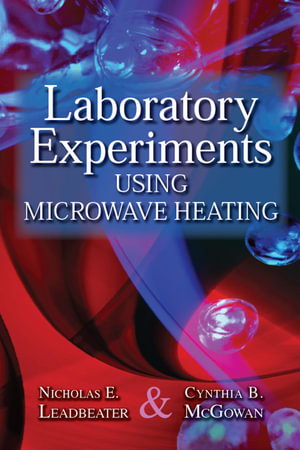
Laboratory Experiments Using Microwave Heating - Nicholas E. Leadbeater

Laboratory Experiments Using Microwave Heating

By: Nicholas E. Leadbeater, Cynthia B. McGowan

eText | 24 April 2013 | Edition Number 1

At a Glance

eText


$206.79

or 4 interest-free payments of $51.70 with

 or 

Instant online reading in your Booktopia eTextbook Library *

Why choose an eTextbook?

Instant Access *

Purchase and read your book immediately

Read Aloud

Listen and follow along as Bookshelf reads to you

Study Tools

Built-in study tools like highlights and more

* eTextbooks are not downloadable to your eReader or an app and can be accessed via web browsers only. You must be connected to the internet and have no technical issues with your device or browser that could prevent the eTextbook from operating.

Allowing many chemical reactions to be completed within minutes, microwave heating has revolutionized preparative chemistry. As a result, this technology has been widely adopted in both academic and industrial laboratories. Integrating microwave-assisted chemistry into undergraduate laboratory courses enables students to perform a broader range of reactions in the allotted lab period. As a result, they can be introduced to chemistry that would otherwise have been inaccessible due to time constraints (for example, the need for an overnight reflux).

Laboratory Experiments Using Microwave Heating provides 22 experiments encompassing organic, inorganic, and analytical chemistry performed using microwave heating as a tool, making them fast and easy to accomplish in a laboratory period. Utilizing the time-saving experiments described in this book also permits students to repeat experiments if necessary or attempt additional self-designed experiments during the lab course.

A number of the chemical transformations use water as a solvent in lieu of classical organic solvents. This contributes to greener, more sustainable teaching strategies for faculty and students, while maintaining high reaction yields. All the experiments have been tested and verified in laboratory classes, and many were even developed by students. Each chapter includes an introduction to the experiment and two protocols—one for use with a smaller monomode microwave unit employing a single reaction vessel and one for use with a larger multimode microwave unit employing a carousel of reaction vessels.

on
Desktop
Tablet
Mobile

More in Organic Chemistry

The Killer Strain : Anthrax and a Government Exposed - Marilyn W. Thompson

eBOOK

Synthesis of Best-Seller Drugs : Volume 2 - Ruben Vardanyan

eBOOK

RRP $283.59

$255.99

10%
OFF
The Alkaloids : The Alkaloids : Book 96 - Hans-Joachim Knolker

eBOOK

RRP $424.50

$382.13

10%
OFF
Microreactor Technology - Satyabrata Si

eTEXT