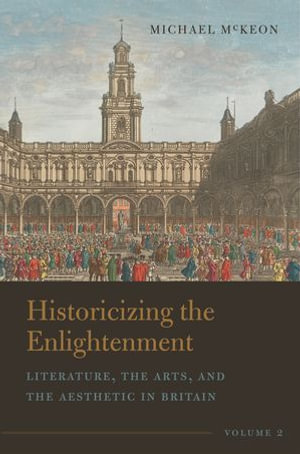
Enlightenment critics from Dryden through Johnson and Wordsworth conceived the modern view that art and especially literature entails a double reflection: a reflection of the world, and a reflection on the process by which that reflection is accomplished. Instead "neoclassicism" and "Augustanism" have been falsely construed as involving a one-dimensional imitation of classical texts and an unselfconscious representation of the world. In fact these Enlightenment movements adopted an oblique perspective that registers the distance between past tradition and its present reenactment, between representation and presence. Two modern movements, Romanticism and modernism, have appropriated as their own these innovations, which derive from Enlightenment thought. Both of these movements ground their error in a misreading of "imitation" as understood by Aristotle and his Enlightenment proponents. Rightly understood, neoclassical imitation, constitutively aware of the difference between what it knows and how it knows it, is an experimental inquiry that generates a range of prefixes—"counter-," "mock-," "anti-," "neo-"—that mark formal degrees of its epistemological detachment. Romantic ideology has denied the role of the imagination in Enlightenment imitation, imposing on the eighteenth century a dichotomous periodization: duplication versus imagination, the mirror versus the lamp. Structuralist ideology has dichotomized narration and description, form and content, structure and history. Poststructuralist ideology has propounded for the novel a contradictory "novel tradition"—realism, modernism, postmodernism, postcolonialism—whose stages both constitute a sequence and collapse it, each stage claiming the innovation of the stage that precedes it.
Published by Bucknell University Press. Distributed worldwide by Rutgers University Press.