

Get Free Shipping on orders over $79
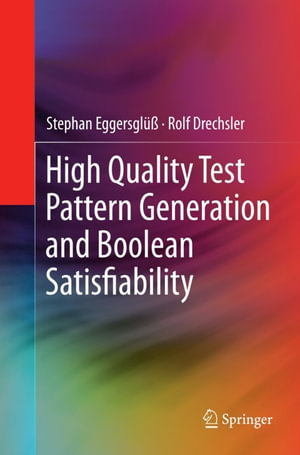
High Quality Test Pattern Generation and Boolean Satisfiability - Stephan Eggersglüß

High Quality Test Pattern Generation and Boolean Satisfiability

By: Stephan Eggersglüß, Rolf Drechsler

eText | 1 February 2012

At a Glance

eText


$159.01

or 4 interest-free payments of $39.75 with

 or 

Instant online reading in your Booktopia eTextbook Library *

Why choose an eTextbook?

Instant Access *

Purchase and read your book immediately

Read Aloud

Listen and follow along as Bookshelf reads to you

Study Tools

Built-in study tools like highlights and more

* eTextbooks are not downloadable to your eReader or an app and can be accessed via web browsers only. You must be connected to the internet and have no technical issues with your device or browser that could prevent the eTextbook from operating.
This book provides an overview of automatic test pattern generation (ATPG) and introduces novel techniques to complement classical ATPG, based on Boolean Satisfiability (SAT).  A fast and highly fault efficient SAT-based ATPG framework is presented which is also able to generate high-quality delay tests such as robust path delay tests, as well as tests with long propagation paths to detect small delay defects.   The aim of the techniques and methodologies presented in this book is to improve SAT-based ATPG, in order to make it applicable in industrial practice. Readers will learn to improve the performance and robustness of the overall test generation process, so that the ATPG algorithm reliably will generate test patterns for most targeted faults in acceptable run time to meet the high fault coverage demands of industry. The techniques and improvements presented in this book provide the following advantages:   Provides a comprehensive introduction to test generation and Boolean Satisfiability (SAT);  Describes a highly fault efficient SAT-based ATPG framework; Introduces circuit-oriented SAT solving techniques, which make use of structural information and are able to accelerate the search process significantly; Provides SAT formulations for the prevalent delay faults models, in addition to the classical stuck-at fault model; Includes an industrial perspective on the state-of-the-art in the testing, along with SAT; two topics typically distinguished from each other.
on
Desktop
Tablet
Mobile

More in Circuits & Components