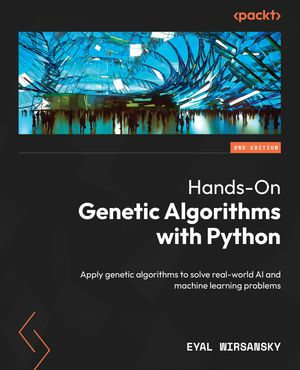
Explore the ever-growing world of genetic algorithms to build and enhance AI applications involving search, optimization, machine learning, deep learning, NLP, and XAI, using Python libraries such as DEAP, scikit-learn, and NumPy
Key Features
- Learn how to implement genetic algorithms using state-of-the-art Python tools
- Take advantage of cloud computing technology to increase the performance of your solutions
- Discover bio-inspired algorithms such as particle swarm optimization (PSO) and NEAT
- Purchase of the print or Kindle book includes a free PDF eBook
Book Description
Genetic algorithms are a family of search, optimization, and learning algorithms inspired by the principles of natural evolution. This book will guide you in harnessing the power of genetic algorithms, applying them to a wide range of tasks, and using them in artificial intelligence applications with Python. After getting an introduction to genetic algorithms and their principles of operation, you'll find out how they differ from traditional algorithms and the types of problems they can solve. You'll then discover how they can be applied to search and optimization tasks, such as planning, scheduling, gaming, and analytics. As you progress, you'll delve into explainable AI and learn how to apply genetic algorithms to AI to improve machine learning and deep learning models as well as tackle reinforcement learning and NLP tasks. This updated second edition further expands on applying genetic algorithms to NLP and XAI and speeding up genetic algorithms with concurrency and cloud computing. Later, you'll get to grips with the NEAT algorithm. The book concludes with an image reconstruction project, followed by covering other related technologies for future applications. By the end of this book, you'll have gained hands-on experience in applying genetic algorithms across a variety of fields, with emphasis on artificial intelligence.
What you will learn
- Use genetic algorithms to solve planning, scheduling, gaming, and analytics problems
- Create reinforcement learning, NLP, and explainable AI applications
- Enhance the performance of ML models and optimize deep learning architecture
- Deploy genetic algorithms using client-server architectures, enhancing scalability and computational efficiency
- Explore how images can be reconstructed using a set of semi-transparent shapes
- Delve into topics like elitism, niching, and multiplicity in genetic solutions to enhance optimization strategies and solution diversity
Who this book is for
If you're a data scientist, software developer, or AI enthusiast who wants to break into the world of genetic algorithms and apply them to real-world, intelligent applications as quickly as possible, this book is for you. Working knowledge of the Python programming language is required to get started with this book.