

Get Free Shipping on orders over $79
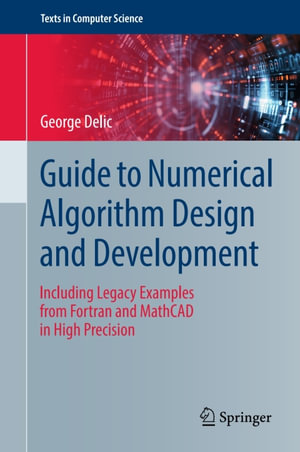
Guide to Numerical Algorithm Design and Development : Including Legacy Examples from Fortran and MathCAD in High Precision - George Delic

Guide to Numerical Algorithm Design and Development

Including Legacy Examples from Fortran and MathCAD in High Precision

By: George Delic

eText | 27 October 2025

At a Glance

eText


$129.00

or 4 interest-free payments of $32.25 with

 or 

Instant online reading in your Booktopia eTextbook Library *

Why choose an eTextbook?

Instant Access *

Purchase and read your book immediately

Read Aloud

Listen and follow along as Bookshelf reads to you

Study Tools

Built-in study tools like highlights and more

* eTextbooks are not downloadable to your eReader or an app and can be accessed via web browsers only. You must be connected to the internet and have no technical issues with your device or browser that could prevent the eTextbook from operating.
The focus of this unique textbook/reference is on numerical algorithms that are stable and provide high precision in common numerical problems encountered in large-scale modeling projects.  The techniques presented are based on algorithms developed by the author over six decades of research and publications in peer-reviewed journals. The exposition includes topics typical of numerical analysis courses and is supplemented with examples of algorithms demonstrated in an engineering worksheet that is easy to read and comprehend. Each chapter ends with exercises and programming problems. Additional examples are available as downloadable Fortran code based on the author's large-scale models in computational physics. The limitations of commodity processors and modern compilers is discussed, with advice provided on how to control them in an algorithm's code design. An ample bibliography of over 200 citations provides a guide to further reading. Topics, features, and emphases: ·         Stability: knowing the range of algorithm parameters for producing reliable results ·         Accuracy: understanding convergence to a result through quantitative metrics ·         Precision: advance knowledge of the expected numerical precision and how to control it  ·         Efficiency: translating an algorithm into code with limited redundant computation The primary target audience of this textbook/guide are senior graduate (or postgraduate) students in computer science and scientific or engineering fields who are starting on a career path as the next generation of model developers for high-performance computing (HPC). Additionally, the book will appeal to professionals engaged in large-scale computer model development who could use the volume as a course supplement or reference.     The author is an Honorary Fellow of the University of Wollongong, New South Wales, Australia.  He is active as a private consultant in HPC and CEO of HiPERiSM Consulting, LLC, in the United States of America.
on
Desktop
Tablet
Mobile

More in Computer Science

Amazon.com : Get Big Fast - Robert Spector

eBOOK

This is For Everyone - Tim Berners-Lee

eBOOK