Get Free Shipping on orders over $79
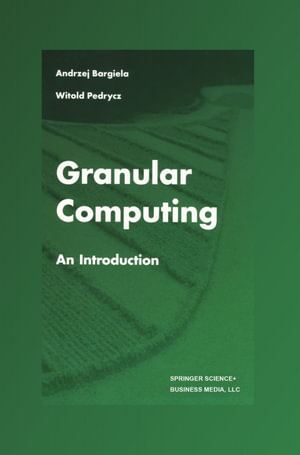
Granular Computing : An Introduction - Andrzej Bargiela

Granular Computing

An Introduction

By: Andrzej Bargiela, Witold Pedrycz

eText | 6 December 2012

At a Glance

eText


$319.00

or 4 interest-free payments of $79.75 with

 or 

Instant online reading in your Booktopia eTextbook Library *

Why choose an eTextbook?

Instant Access *

Purchase and read your book immediately

Read Aloud

Listen and follow along as Bookshelf reads to you

Study Tools

Built-in study tools like highlights and more

* eTextbooks are not downloadable to your eReader or an app and can be accessed via web browsers only. You must be connected to the internet and have no technical issues with your device or browser that could prevent the eTextbook from operating.
This book is about Granular Computing (GC) - an emerging conceptual and of information processing. As the name suggests, GC concerns computing paradigm processing of complex information entities - information granules. In essence, information granules arise in the process of abstraction of data and derivation of knowledge from information. Information granules are everywhere. We commonly use granules of time (seconds, months, years). We granulate images; millions of pixels manipulated individually by computers appear to us as granules representing physical objects. In natural language, we operate on the basis of word-granules that become crucial entities used to realize interaction and communication between humans. Intuitively, we sense that information granules are at the heart of all our perceptual activities. In the past, several formal frameworks and tools, geared for processing specific information granules, have been proposed. Interval analysis, rough sets, fuzzy sets have all played important role in knowledge representation and processing. Subsequently, information granulation and information granules arose in numerous application domains. Well-known ideas of rule-based systems dwell inherently on information granules. Qualitative modeling, being one of the leading threads of AI, operates on a level of information granules. Multi-tier architectures and hierarchical systems (such as those encountered in control engineering), planning and scheduling systems all exploit information granularity. We also utilize information granules when it comes to functionality granulation, reusability of information and efficient ways of developing underlying information infrastructures.
on
Desktop
Tablet
Mobile

More in Artificial Intelligence

AI-Powered Search - Trey Grainger

eBOOK

AI : The End of Human Race - Alex Wood

eBOOK

HBR Guide to Generative AI for Managers : HBR Guide - Elisa Farri

eBOOK