Get Free Shipping on orders over $79
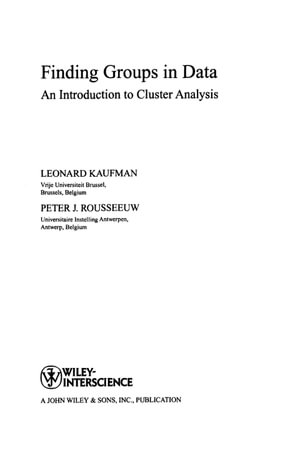
Finding Groups in Data : An Introduction to Cluster Analysis - Leonard Kaufman

Finding Groups in Data

An Introduction to Cluster Analysis

By: Leonard Kaufman

eText | 25 September 2009 | Edition Number 1

At a Glance

eText


$224.39

or 4 interest-free payments of $56.10 with

 or 

Instant online reading in your Booktopia eTextbook Library *

Why choose an eTextbook?

Instant Access *

Purchase and read your book immediately

Read Aloud

Listen and follow along as Bookshelf reads to you

Study Tools

Built-in study tools like highlights and more

* eTextbooks are not downloadable to your eReader or an app and can be accessed via web browsers only. You must be connected to the internet and have no technical issues with your device or browser that could prevent the eTextbook from operating.
The Wiley-Interscience Paperback Series consists of selected books that have been made more accessible to consumers in an effort to increase global appeal and general circulation. With these new unabridged softcover volumes, Wiley hopes to extend the lives of these works by making them available to future generations of statisticians, mathematicians, and scientists.

"Cluster analysis is the increasingly important and practical subject of finding groupings in data. The authors set out to write a book for the user who does not necessarily have an extensive background in mathematics. They succeed very well."
???Mathematical Reviews

"Finding Groups in Data [is] a clear, readable, and interesting presentation of a small number of clustering methods. In addition, the book introduced some interesting innovations of applied value to clustering literature."
???Journal of Classification

"This is a very good, easy-to-read, and practical book. It has many nice features and is highly recommended for students and practitioners in various fields of study."
???Technometrics

An introduction to the practical application of cluster analysis, this text presents a selection of methods that together can deal with most applications. These methods are chosen for their robustness, consistency, and general applicability. This book discusses various types of data, including interval-scaled and binary variables as well as similarity data, and explains how these can be transformed prior to clustering.

on
Desktop
Tablet
Mobile

More in Probability & Statistics