Get Free Shipping on orders over $79
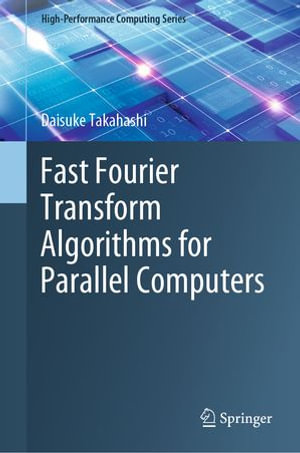
Fast Fourier Transform Algorithms for Parallel Computers : High-Performance Computing Series : Book 2 - Daisuke Takahashi

Fast Fourier Transform Algorithms for Parallel Computers

By: Daisuke Takahashi

eText | 5 October 2019

At a Glance

eText


$209.00

or 4 interest-free payments of $52.25 with

 or 

Instant online reading in your Booktopia eTextbook Library *

Why choose an eTextbook?

Instant Access *

Purchase and read your book immediately

Read Aloud

Listen and follow along as Bookshelf reads to you

Study Tools

Built-in study tools like highlights and more

* eTextbooks are not downloadable to your eReader or an app and can be accessed via web browsers only. You must be connected to the internet and have no technical issues with your device or browser that could prevent the eTextbook from operating.

Following an introduction to the basis of the fast Fourier transform (FFT), this book focuses on the implementation details on FFT for parallel computers. FFT is an efficient implementation of the discrete Fourier transform (DFT), and is widely used for many applications in engineering, science, and mathematics. Presenting many algorithms in pseudo-code and a complexity analysis, this book offers a valuable reference guide for graduate students, engineers, and scientists in the field who wish to apply FFT to large-scale problems.

Parallel computation is becoming indispensable in solving the large-scale problems increasingly arising in a wide range of applications. The performance of parallel supercomputers is steadily improving, and it is expected that a massively parallel system with hundreds of thousands of compute nodes equipped with multi-core processors and accelerators will be available in the near future. Accordingly, the book also provides up-to-date computational techniquesrelevant to the FFT in state-of-the-art parallel computers.

Following the introductory chapter, Chapter 2 introduces readers to the DFT and the basic idea of the FFT. Chapter 3 explains mixed-radix FFT algorithms, while Chapter 4 describes split-radix FFT algorithms. Chapter 5 explains multi-dimensional FFT algorithms, Chapter 6 presents high-performance FFT algorithms, and Chapter 7 addresses parallel FFT algorithms for shared-memory parallel computers. In closing, Chapter 8 describes parallel FFT algorithms for distributed-memory parallel computers.

on
Desktop
Tablet
Mobile

Other Editions and Formats

Paperback

Published: 17th October 2020

More in Algorithms & Data Structures

Addiction by Design : Machine Gambling in Las Vegas - Natasha Dow Schüll

eBOOK