

Get Free Shipping on orders over $79
Evolution : A Scientific American Reader - Scientific American

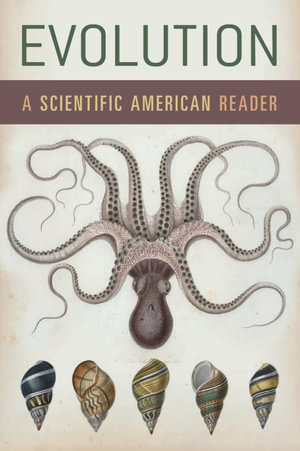
Evolution

A Scientific American Reader

By: Scientific American

eText | 15 September 2008 | Edition Number 1

At a Glance

eText


$41.22

or 4 interest-free payments of $10.30 with

 or 

Instant online reading in your Booktopia eTextbook Library *

Why choose an eTextbook?

Instant Access *

Purchase and read your book immediately

Read Aloud

Listen and follow along as Bookshelf reads to you

Study Tools

Built-in study tools like highlights and more

* eTextbooks are not downloadable to your eReader or an app and can be accessed via web browsers only. You must be connected to the internet and have no technical issues with your device or browser that could prevent the eTextbook from operating.
From the Scopes "Monkey Trial" of 1925 to the court ruling against the Dover Area School Board's proposed intelligent design curriculum in 2005, few scientific topics have engendered as much controversy—or grabbed as many headlines—as evolution. And since the debate shows no signs of abating, there is perhaps no better time to step back and ask: What is evolution? Defined as the gradual process by which something changes into a different and usually more complex and efficient form, evolution explains the formation of the universe, the nature of viruses, and the emergence of humans. A first-rate summary of the actual science of evolution, this Scientific American reader is a timely collection that gives readers an opportunity to consider evolution's impact in various settings. Divided into four sections that consider the evolution of the universe, cells, dinosaurs, and humans, Evolution brings together more than thirty articles written by some of the world's most respected evolutionary scientists. As tour guides through the genesis of the universe and complex cells, P. James E. Peebles examines the evidence in support of an expanding cosmos, while Christian de Duve discusses the birth of eukaryotes. In an article that anticipated his book Full House, Stephen Jay Gould argues that chance and contingency are as important as natural selection for evolutionary change. And Ian Tatersall makes two fascinating contributions, submitting his view that the schematic of human evolution looks less like a ladder and more like a bush. With the latest on what's being researched at every level of evolutionary studies, from prospects of life on other planets to the inner working of cells, Evolution offers general readers an opportunity to update their knowledge on this hot topic while giving students an introduction to the problems and methodologies of an entire field of inquiry. 
on
Desktop
Tablet
Mobile

More in Science in General

Tesla : Man Out of Time - Margaret Cheney

eBOOK

Men of Mathematics - E.T. Bell

eBOOK

Because He Could - Dick Morris

eBOOK

RRP $25.99

$20.99

19%
OFF
Ike : An American Hero - Michael Korda

eBOOK