Get Free Shipping on orders over $79
Efficient Polymorphic Calls - Karel Driesen

Efficient Polymorphic Calls

By: Karel Driesen

eText | 6 December 2012

At a Glance

eText


$239.00

or 4 interest-free payments of $59.75 with

 or 

Instant online reading in your Booktopia eTextbook Library *

Why choose an eTextbook?

Instant Access *

Purchase and read your book immediately

Read Aloud

Listen and follow along as Bookshelf reads to you

Study Tools

Built-in study tools like highlights and more

* eTextbooks are not downloadable to your eReader or an app and can be accessed via web browsers only. You must be connected to the internet and have no technical issues with your device or browser that could prevent the eTextbook from operating.
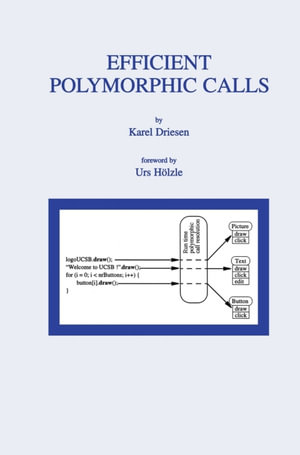
The implementation of object-oriented languages has been an active topic of research since the 1960s when the first Simula compiler was written. The topic received renewed interest in the early 1980s with the growing popularity of object-oriented programming languages such as c and Smalltalk, and got another boost with the advent of Java. Polymorphic calls are at the heart of object-oriented languages, and even the first implementation of Simula-67 contained their classic implementation via virtual function tables. In fact, virtual function tables predate even Simula-for example, Ivan Sutherland's Sketchpad drawing editor employed very similar structures in 1960. Similarly, during the 1970s and 1980s the implementers of Smalltalk systems spent considerable efforts on implementing polymorphic calls for this dynamically typed language where virtual function tables could not be used. Given this long history of research into the implementation of polymorphic calls, and the relatively mature standing it achieved over time, why, one might ask, should there be a new book in this field? The answer is simple. Both software and hardware have changed considerably in recent years, to the point where many assumptions underlying the original work in this field are no longer true. In particular, virtual function tables are no longer sufficient to implement polymorphic calls even for statically typed languages; for example, Java's interface calls cannot be implemented this way. Furthermore, today's processors are deeply pipelined and can execute instructions out-of­ order, making it difficult to predict the execution time of even simple code sequences.
on
Desktop
Tablet
Mobile

Other Editions and Formats

Paperback

Published: 26th October 2012

More in Computer Architecture & Logic Design

Quantum Computing - Alex Wood

eBOOK

Think Distributed Systems - Dominik Tornow

eBOOK