


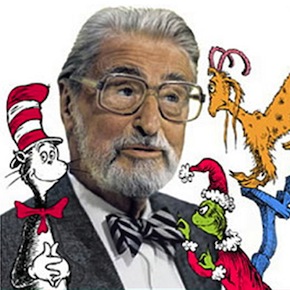
Dr Seuss
"I have heard there are troubles of more than one kind. Some come from ahead and some come from behind. But I've bought a big bat. I'm ready you see. Now my troubles are going to have troubles with me."
In 1936 on the way to a vaction in Europe, listening to the rhythm of the ship's engines, he came up with And to Think That I Saw It on Mulberry Street, which was then promptly rejected by the first 43 publishers he showed it to. Eventually in 1937 a friend published the book for him, and it went on to at least moderate success.
During WWII, Geisel joined the army and was sent to Hollywood. Captain Geisel would write for Frank Capra's Signal Corps Unit (for which he won the Legion of Merit) and do documentaries (he won Oscars for Hitler Lives and Design for Death). He also created a cartoon called Gerald McBoing-Boing which also won him an Oscar.
In May of 1954, Life published a report concerning illiteracy among school children. The report said, among other things, that children were having trouble to read because their books were boring. This inspired Geisel's publisher, and prompted him to send Geisel a list of 400 words he felt were important, asked him to cut the list to 250 words (the publisher's idea of how many words at one time a first grader could absorb), and write a book. Nine months later, Geisel, using 220 of the words given to him published The Cat in the Hat, which went on to instant success.
In 1960 Bennett Cerf bet Geisel $50 that he couldn't write an entire book using only fifty words. The result was Green Eggs and Ham. Cerf never paid the $50 from the bet.
Helen Palmer Geisel died in 1967. Theodor Geisel married Audrey Stone Diamond in 1968. Theodor Seuss Geisel died 24 September 1991.
What kinds of books did Dr Seuss write?
He wrote illustrated children's picture books and early reader titles known for playful rhymes, inventive characters, and creative word play. Many of his works were published as Beginner Books to support young readers.
Which Dr Seuss book is best to start with?
A good starting point is The Cat in the Hat because it was written specifically to engage early readers. Other widely loved entry points include Green Eggs and Ham, How the Grinch Stole Christmas, Horton Hears a Who, and The Lorax.
Are Dr Seuss books suitable for early readers and what age are they aimed at?
Yes. Many books were created for preschool and early elementary children; The Cat in the Hat was written using a limited vocabulary for first graders, and Green Eggs and Ham was written using only fifty words as a simple-reader exercise.
What common themes appear in Dr Seuss's work?
Frequent themes include imagination and creativity, language play and rhyme, and moral or social messages such as environmental stewardship and respect for others, illustrated in books like The Lorax and Horton Hears a Who.
Did Dr Seuss receive any notable awards for his work?
He earned recognition for his wartime film work, including Oscars for documentary films and a Legion of Merit for his service writing for the Signal Corps. He also won an Oscar connected to the Gerald McBoing-Boing project.
Popular Books By Dr Seuss

RRP $39.99
$35.75
OFF


RRP $14.99
$14.75
All Dr Seuss Books


RRP $39.99
$35.75
OFF

RRP $14.99
$14.75


RRP $16.99
$15.99


RRP $29.99
$28.99
RRP $14.99
$14.75

RRP $11.99
$11.75

RRP $19.99
$18.75


RRP $11.99
$11.75

RRP $11.99
$11.75

RRP $11.99
$11.75


RRP $11.99
$11.75

RRP $11.99
$11.75


RRP $11.99
$11.75

RRP $12.99
$12.75

RRP $12.99
$12.75

RRP $11.99
$11.75

RRP $24.99
$21.75
OFF

RRP $34.99
$32.75

RRP $34.99
$28.75
OFF

RRP $11.99
$11.75

RRP $11.99
$11.75


RRP $14.99
$14.75

RRP $14.99
$14.75

RRP $14.99
$14.75

RRP $12.99
$12.75

RRP $12.99
$12.75

RRP $12.99
$12.75

RRP $14.99
$14.75

RRP $11.99
$11.75

RRP $11.99
$11.75


