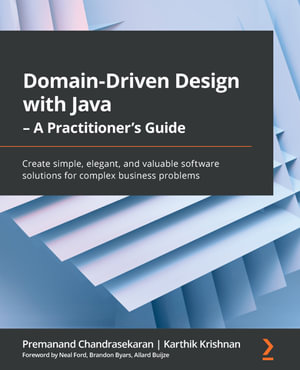
Adopt a practical and modern approach to architecting and implementing DDD-inspired solutions to translate abstract business ideas into working software across the entire spectrum of the software development lifecycle
Key Features
- Implement DDD principles to build simple, effective, and well-factored solutions
- Use lightweight modeling techniques to draw a mutual conclusion of the problem domain within the organization
- Decompose monolithic applications into loosely coupled, distributed components using modern design patterns
Book Description
Domain-Driven Design (DDD) makes available a set of techniques and patterns that enable domain experts, architects, and developers to work together to decompose complex business problems into a set of well-factored, collaborating, and loosely coupled subsystems.
This practical guide will help you as a developer to put your knowledge to work in order to create elegant software designs that are enjoyable to work with and easy to reason about. You'll begin with an introduction to the concepts of domain-driven design and discover various ways to apply them in real-world scenarios. You'll also appreciate how DDD is extremely relevant when creating cloud-native solutions that employ modern techniques such as event-driven microservices and serverless architectures. As you advance through the chapters, you'll get acquainted with core DDD concepts such as the ubiquitous language, context maps, bounded contexts, strategic and tactical design, and anti-corruption layers. You'll also understand how to apply modern, lightweight modeling techniques such as domain storytelling and EventStorming before learning how to test-drive the system to create solutions that exhibit high degrees of internal quality.
By the end of this book, you'll be able to architect, design, and implement robust, resilient, and performant distributed software solutions.
What you will learn
- Discover how to arrive at a shared understanding of the problem domain
- Identify how to evolve and decompose complex systems into well-factored components
- Establish a clear demarcation between core and peripheral systems
- Apply elaboration techniques such as domain storytelling and EventStorming
- Gain a solid understanding of how to apply EDA, CQRS, Event Sourcing, and much more
- Design an ecosystem of cohesive, loosely coupled, and distributed microservices
- Test-drive the implementation of an event-driven system in Java
Who This Book Is For
This book is for Intermediate Java programmers looking to upgrade their software engineering skills and adopt a collaborative and structured approach to designing complex software systems. It will also assist technical leads in understanding domain-driven design and implementing it in their organization Although familiarity with DDD techniques is not required, working knowledge of Java is expected.
Table of Contents
- The Rationale for Domain-Driven Design
- The Mechanics of Domain-Driven Design
- Where and How Does DDD Fit?
- Domain Analysis and Modeling Using EventStorming
- Implementing Domain Logic
- Implementing the User Interface - Task-Based
- Implementing Queries
- Long-Running Flows
- Integrating with External Systems
- Distributing into Microservices
- Non-Functional Requirements
- Migrating to Serverless