Get Free Shipping on orders over $79
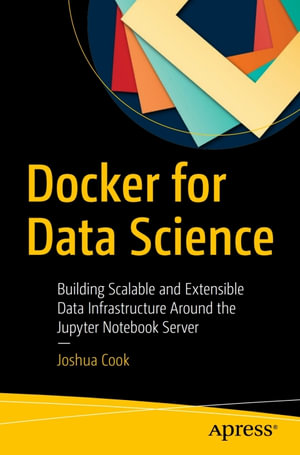
Docker for Data Science : Building Scalable and Extensible Data Infrastructure Around the Jupyter Notebook Server - Joshua Cook

Docker for Data Science

Building Scalable and Extensible Data Infrastructure Around the Jupyter Notebook Server

By: Joshua Cook

eText | 23 August 2017

At a Glance

eText


$54.99

or 4 interest-free payments of $13.75 with

 or 

Instant online reading in your Booktopia eTextbook Library *

Why choose an eTextbook?

Instant Access *

Purchase and read your book immediately

Read Aloud

Listen and follow along as Bookshelf reads to you

Study Tools

Built-in study tools like highlights and more

* eTextbooks are not downloadable to your eReader or an app and can be accessed via web browsers only. You must be connected to the internet and have no technical issues with your device or browser that could prevent the eTextbook from operating.

Learn Docker "infrastructure as code" technology to define a system for performing standard but non-trivial data tasks on medium- to large-scale data sets, using Jupyter as the master controller.

It is not uncommon for a real-world data set to fail to be easily managed. The set may not fit well into access memory or may require prohibitively long processing. These are significant challenges to skilled software engineers and they can render the standard Jupyter system unusable.

As a solution to this problem, Docker for Data Science proposes using Docker. You will learn how to use existing pre-compiled public images created by the major open-source technologies—Python, Jupyter, Postgres—as well as using the Dockerfile to extend these images to suit your specific purposes. The Docker-Compose technology is examined and you will learn how it can be used to build a linked system with Python churning data behind the scenesand Jupyter managing these background tasks. Best practices in using existing images are explored as well as developing your own images to deploy state-of-the-art machine learning and optimization algorithms.

What You'll Learn

  • Master interactive development using the Jupyter platform

  • Run and build Docker containers from scratch and from publicly available open-source images

  • Write infrastructure as code using the docker-compose tool and its docker-compose.yml file type

  • Deploy a multi-service data science application across a cloud-based system

Who This Book Is For

Data scientists, machine learning engineers, artificial intelligence researchers, Kagglers, and software developers

on
Desktop
Tablet
Mobile

More in Programming & Scripting Languages

Foundations of Cloud Computing : Foundations - Robert Shimonski

eBOOK

RRP $209.94

$188.99

10%
OFF
The Rust Programming Language, 3rd Edition - Carol Nichols

eBOOK

Thinking in Calculus - Nick McIntyre

eBOOK

RRP $67.77

$54.99

19%
OFF
Grokking Statistics - Thomas Nield

eBOOK