Get Free Shipping on orders over $79
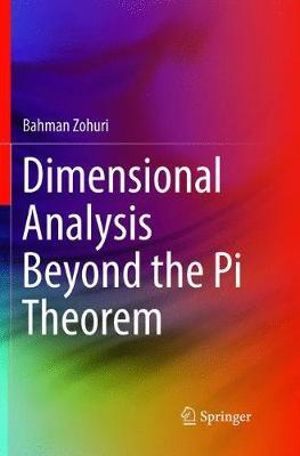
Dimensional Analysis Beyond the Pi Theorem - Bahman Zohuri

Dimensional Analysis Beyond the Pi Theorem

By: Bahman Zohuri

eText | 2 November 2016

At a Glance

eText


$179.00

or 4 interest-free payments of $44.75 with

 or 

Instant online reading in your Booktopia eTextbook Library *

Why choose an eTextbook?

Instant Access *

Purchase and read your book immediately

Read Aloud

Listen and follow along as Bookshelf reads to you

Study Tools

Built-in study tools like highlights and more

* eTextbooks are not downloadable to your eReader or an app and can be accessed via web browsers only. You must be connected to the internet and have no technical issues with your device or browser that could prevent the eTextbook from operating.

Dimensional Analysis and Physical Similarity are well understood subjects, and the general concepts of dynamical similarity are explained in this book. Our exposition is essentially different from those available in the literature, although it follows the general ideas known as Pi Theorem. There are many excellent books that one can refer to; however, dimensional analysis goes beyond Pi theorem, which is also known as Buckingham's Pi Theorem. Many techniques via self-similar solutions can bound solutions to problems that seem intractable.

A time-developing phenomenon is called self-similar if the spatial distributions of its properties at different points in time can be obtained from one another by a similarity transformation, and identifying one of the independent variables as time. However, this is where Dimensional Analysis goes beyond Pi Theorem into self-similarity, which has represented progress for researchers.

In recent years there has been a surge of interest in self-similar solutions of the First and Second kind. Such solutions are not newly discovered; they have been identified and named by Zel'dovich, a famous Russian Mathematician in 1956. They have been used in the context of a variety of problems, such as shock waves in gas dynamics, and filtration through elasto-plastic materials.

Self-Similarity has simplified computations and the representation of the properties of phenomena under investigation. It handles experimental data, reduces what would be a random cloud of empirical points to lie on a single curve or surface, and constructs procedures that are self-similar. Variables can be specifically chosen for the calculations.

on
Desktop
Tablet
Mobile

Other Editions and Formats

Paperback

Published: 28th June 2018

More in Applied Mathematics

Discrete and Computational Geometry, 2nd Edition - Satyan L. Devadoss

eBOOK

Markov Chains : Theory and Applications - C.R. Rao

eBOOK

RRP $359.04

$323.99

10%
OFF
Mathematics for Engineers - Ritu Shrivastava

eBOOK

Grape Explications - Neal D. Hulkower

eBOOK

RRP $18.69

$17.99

Handbook of Computer Architecture - Anupam Chattopadhyay

eBOOK

RRP $969.00

$872.99

10%
OFF
Pi the Laws of Duality - G. Neal

eBOOK