Get Free Shipping on orders over $89
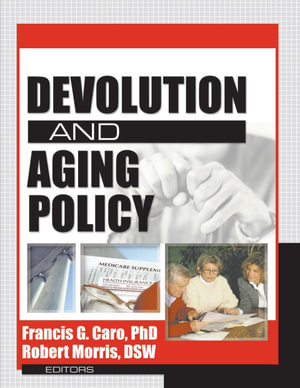
Devolution and Aging Policy - Francis G Caro

Devolution and Aging Policy

By: Francis G Caro, Robert Morris *Deceased*

eText | 12 October 2012 | Edition Number 1

At a Glance

eText


$121.00

or 4 interest-free payments of $30.25 with

 or 

Instant online reading in your Booktopia eTextbook Library *

Why choose an eTextbook?

Instant Access *

Purchase and read your book immediately

Read Aloud

Listen and follow along as Bookshelf reads to you

Study Tools

Built-in study tools like highlights and more

* eTextbooks are not downloadable to your eReader or an app and can be accessed via web browsers only. You must be connected to the internet and have no technical issues with your device or browser that could prevent the eTextbook from operating.
Explore significant—but often-overlooked—aspects of aging policy!

This unique addition to the literature on aging policy will help you understand devolution—the decentralizing of service provision—and the roles that state/local government and private organizations now play in addressing the needs of our aging population. It will show you how to initiate innovations and make positive changes in aging policy through state and local initiatives, collaborations between the federal government and other government agencies, public/private collaboration, and strictly private initiatives.

From the editors: “Around the world, the ground rules are being questioned about the role of national governments in addressing domestic needs. During the twentieth century in countries throughout the world, central governments assumed major responsibilities for a wide variety of human needs. Whether the concern was income security, health, housing, or education, interventions were premised upon convictions that a strong public sector role was essential and that major involvement of national governments was needed. More recently, a significant pattern [devolution] has emerged in many countries wherein these responsibilities have shifted away from national governments to regional and local governments as well as from the public to the private sector.”

Thoughtfully divided into five sections that illustrate distinctly different forms of devolution, this book first provides an essential overview of devolution and then examines its implications for vital aspects of service provision to the elderly. In the United States in recent years, the single greatest focus for devolution has been the transformation of income security protections for poor families. The federal Aid to Families With Dependent Children program has been replaced by the Temporary Assistance to Needy Families program. Devolution and Aging Policy examines that change and other important facets of the current climate of devolution, including:
  • Medicaid-financed long-term care
  • state sponsorship of services in retirement communities
  • the implications of the Workforce Investment Act for the access of older workers to training at a state level to upgrade their work skills
  • public/private sector collaboration in long-term care insurance
  • long-term care ombudsman programs
  • what state governments can do to help elders make use of information technology
  • property tax credits for seniors that are given in exchange for volunteering on the municipal level
  • how an HMO can encourage and stimulate service coordination
  • and more!
on
Desktop
Tablet
Mobile

Other Editions and Formats

Hardcover

Published: 25th June 2003

More in Health Systems & Services

The Rosedale Diet - Ron Rosedale

eBOOK

RRP $29.99

$24.99

17%
OFF