

Get Free Shipping on orders over $79
Developing a Residency Program : A Practical Guide for Librarians - Lorelei Rutledge

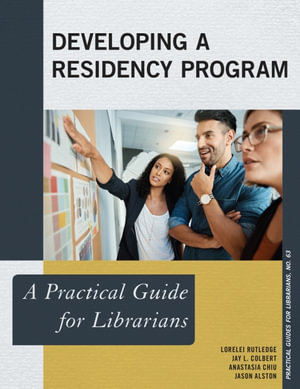
Developing a Residency Program

A Practical Guide for Librarians

By: Lorelei Rutledge, Jay L. Colbert, Anastasia Chiu, Jason Alston

eText | 15 April 2019 | Edition Number 1

At a Glance

eText


$117.00

or 4 interest-free payments of $29.25 with

 or 

Instant online reading in your Booktopia eTextbook Library *

Why choose an eTextbook?

Instant Access *

Purchase and read your book immediately

Read Aloud

Listen and follow along as Bookshelf reads to you

Study Tools

Built-in study tools like highlights and more

* eTextbooks are not downloadable to your eReader or an app and can be accessed via web browsers only. You must be connected to the internet and have no technical issues with your device or browser that could prevent the eTextbook from operating.
Library residency programs can be a great opportunity for early-career librarians to learn on-the-job-skills, determine their interests in librarianship, and develop a valuable career network. Likewise, such programs benefit the profession, the hosting organizations, and other organizational stakeholders. Developing a Residency Program: A Practical Guide for Librarians draws together scholarly literature, best practices, and the experiences of the authors and their contributors to provide practical advice about how to develop and manage a library residency program. The first two chapters of this book offer a brief overview of library residency programs and illustrate the benefits that such programs can provide. Chapters 3 describes strategies for building support for such a program, while Chapters 4 and 5 provide insight on best practices for structuring a residency program. Chapter 6 focuses on the recruitment and hiring process, emphasizing the need for a reasoned and objective approach to selecting a candidate. Chapters 7 and 8 offer best practices for preparing for new resident's arrival and onboarding the resident successfully. Chapter 9 offers ideas for how to assess and evaluate multiple aspects of the residency program, while Chapter 10 focuses on supporting the resident after the residency is over. In each chapter, the authors include practical tips and tools to make each part of the planning and management process easier.
on
Desktop
Tablet
Mobile

More in Library & Information Services

Information Science : History, Ideas, Applications - Michael Seadle

eBOOK