Get Free Shipping on orders over $79
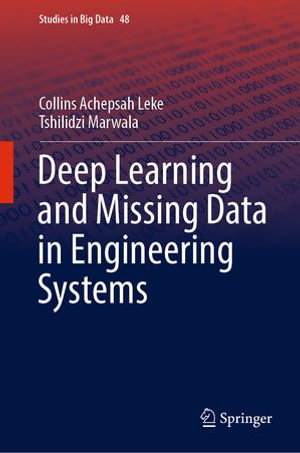
Deep Learning and Missing Data in Engineering Systems : Intelligent Technologies and Robotics (R0) - Collins Achepsah Leke

Deep Learning and Missing Data in Engineering Systems

By: Collins Achepsah Leke, Tshilidzi Marwala

eText | 13 December 2018

At a Glance

eText


$239.00

or 4 interest-free payments of $59.75 with

 or 

Instant online reading in your Booktopia eTextbook Library *

Why choose an eTextbook?

Instant Access *

Purchase and read your book immediately

Read Aloud

Listen and follow along as Bookshelf reads to you

Study Tools

Built-in study tools like highlights and more

* eTextbooks are not downloadable to your eReader or an app and can be accessed via web browsers only. You must be connected to the internet and have no technical issues with your device or browser that could prevent the eTextbook from operating.

Deep Learning and Missing Data in Engineering Systems uses deep learning and swarm intelligence methods to cover missing data estimation in engineering systems. The missing data estimation processes proposed in the book can be applied in image recognition and reconstruction. To facilitate the imputation of missing data, several artificial intelligence approaches are presented, including:

  • deep autoencoder neural networks;
  • deep denoising autoencoder networks;
  • the bat algorithm;
  • the cuckoo search algorithm; and
  • the firefly algorithm.

The hybrid models proposed are used to estimate the missing data in high-dimensional data settings more accurately. Swarm intelligence algorithms are applied to address critical questions such as model selection and model parameter estimation. The authors address feature extraction for the purpose of reconstructing the input data from reduced dimensions by the use of deep autoencoder neural networks. They illustrate new models diagrammatically, report their findings in tables, so as to put their methods on a sound statistical basis. The methods proposed speed up the process of data estimation while preserving known features of the data matrix.

This book is a valuable source of information for researchers and practitioners in data science. Advanced undergraduate and postgraduate students studying topics in computational intelligence and big data, can also use the book as a reference for identifying and introducing new research thrusts in missing data estimation.

on
Desktop
Tablet
Mobile

More in Artificial Intelligence

AI-Powered Search - Trey Grainger

eBOOK