Get Free Shipping on orders over $79
Cosmic Gamma-Ray Sources - K.S. Cheng

Cosmic Gamma-Ray Sources

By: K.S. Cheng, ?Gustavo E. Romero

eText | 3 November 2012 | Edition Number 1

At a Glance

eText


$349.00

or 4 interest-free payments of $87.25 with

 or 

Instant online reading in your Booktopia eTextbook Library *

Why choose an eTextbook?

Instant Access *

Purchase and read your book immediately

Read Aloud

Listen and follow along as Bookshelf reads to you

Study Tools

Built-in study tools like highlights and more

* eTextbooks are not downloadable to your eReader or an app and can be accessed via web browsers only. You must be connected to the internet and have no technical issues with your device or browser that could prevent the eTextbook from operating.
Gamma-ray astronomy has undergone an enormous progress in the last 15 years. The success of satellite experiments like NASA's Comp­ ton Gamma-Ray Observatory and ESA's INTEGRAL mission, as well as of ground-based instruments have open new views into the high-energy Universe. Different classes of cosmic gamma-ray sources have been now detected at different energies, in addition to young radio pulsars and gamma-ray bursts, the classical ones. The new sources include radio­ quiet pulsars, microquasars, supernova remnants, starburst galaxies, ra­ dio galaxies, flat-spectrum radio quasars, and BL Lacertae objects. A large number of unidentified sources strongly suggests that this brief enumeration is far from complete. Gamma-ray bursts are now estab­ lished as extragalactic sources with tremendous energy output. There is accumulating evidence supporting the idea that massive stars and star forming regions can accelerate charged particles up to relativistic ener­ gies making them gamma-ray sources. Gamma-ray astronomy has also proved to be a powerful tool for cosmology imposing constraints to the background photon fields that can absorb the gamma-ray flux from dis­ tant sources. All this has profound implications for our current ideas about how particles are accelerated and transported in both the local and distant U niverse. The evolution of our knowledge on the gamma-ray sky has been so fast that is not easy for the non-specialist scientist and the graduate student to be aware of the full potential of this field or to grasp the fundamentals of a given topic in order to attempt some original contribution.
on
Desktop
Tablet
Mobile

More in Astronomy, Space & Time

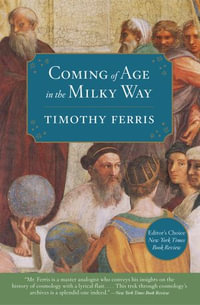
Coming of Age in the Milky Way - Timothy Ferris

eBOOK

RRP $33.99

$27.99

18%
OFF
Mars : A Survival Guide - Guy Murphy

eBOOK

The Ant and the Ferrari - Kerry Spackman

eBOOK

What If ETs Are Real? - L G Rice

eBOOK