Get Free Shipping on orders over $79
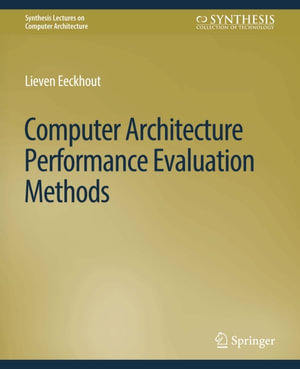
Computer Architecture Performance Evaluation Methods - Lieven Eeckhout

Computer Architecture Performance Evaluation Methods

By: Lieven Eeckhout

eText | 31 May 2022

At a Glance

eText


$50.00

or 4 interest-free payments of $12.50 with

 or 

Instant online reading in your Booktopia eTextbook Library *

Why choose an eTextbook?

Instant Access *

Purchase and read your book immediately

Read Aloud

Listen and follow along as Bookshelf reads to you

Study Tools

Built-in study tools like highlights and more

* eTextbooks are not downloadable to your eReader or an app and can be accessed via web browsers only. You must be connected to the internet and have no technical issues with your device or browser that could prevent the eTextbook from operating.
Performance evaluation is at the foundation of computer architecture research and development. Contemporary microprocessors are so complex that architects cannot design systems based on intuition and simple models only. Adequate performance evaluation methods are absolutely crucial to steer the research and development process in the right direction. However, rigorous performance evaluation is non-trivial as there are multiple aspects to performance evaluation, such as picking workloads, selecting an appropriate modeling or simulation approach, running the model and interpreting the results using meaningful metrics. Each of these aspects is equally important and a performance evaluation method that lacks rigor in any of these crucial aspects may lead to inaccurate performance data and may drive research and development in a wrong direction. The goal of this book is to present an overview of the current state-of-the-art in computer architecture performance evaluation, with a special emphasis on methods for exploring processor architectures. The book focuses on fundamental concepts and ideas for obtaining accurate performance data. The book covers various topics in performance evaluation, ranging from performance metrics, to workload selection, to various modeling approaches including mechanistic and empirical modeling. And because simulation is by far the most prevalent modeling technique, more than half the book's content is devoted to simulation. The book provides an overview of the simulation techniques in the computer designer's toolbox, followed by various simulation acceleration techniques including sampled simulation, statistical simulation, parallel simulation and hardware-accelerated simulation. Table of Contents: Introduction / Performance Metrics / Workload Design / Analytical Performance Modeling / Simulation / Sampled Simulation / Statistical Simulation / Parallel Simulation and Hardware Acceleration / Concluding Remarks
on
Desktop
Tablet
Mobile

More in Circuits & Components