



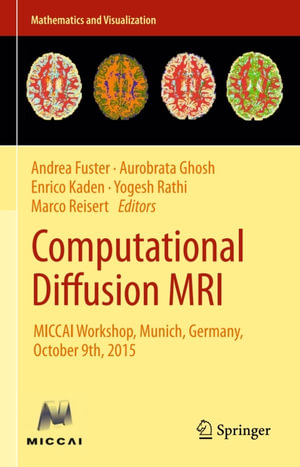
Computational Diffusion MRI
MICCAI Workshop, Munich, Germany, October 9th, 2015
By: Andrea Fuster (Editor), Aurobrata Ghosh (Editor), Enrico Kaden (Editor), Yogesh Rathi (Editor), Marco Reisert (Editor)
eText | 8 April 2016
At a Glance
eText
$219.00
or
Instant online reading in your Booktopia eTextbook Library *
Why choose an eTextbook?
Instant Access *
Purchase and read your book immediately
Read Aloud
Listen and follow along as Bookshelf reads to you
Study Tools
Built-in study tools like highlights and more
* eTextbooks are not downloadable to your eReader or an app and can be accessed via web browsers only. You must be connected to the internet and have no technical issues with your device or browser that could prevent the eTextbook from operating.
ISBN: 9783319285887
ISBN-10: 3319285882
Series: Springer Nature Proceedings excluding Computer Science
Published: 8th April 2016
Format: PDF
Language: English
Publisher: Springer Nature
You Can Find This eBook In


This product is categorised by
- Non-FictionMathematicsCombinatorics & Graph Theory
- Non-FictionComputing & I.T.Graphical & Digital Media Applications3D Graphics & Modelling
- Non-FictionMedicineMedicine in GeneralPublic Health & Preventive MedicineEpidemiology & Medical Statistics
- Non-FictionScienceBiology, Life SciencesLife Sciences in General
- Non-FictionScienceScience in GeneralMaths for Scientists
- Non-FictionMathematicsProbability & Statistics
- Non-FictionComputing & I.T.Computer ScienceHuman-Computer InteractionInformation Visualisation
- Non-FictionMathematicsApplied Mathematics
- Non-FictionComputing & I.T.Computer ScienceArtificial IntelligenceComputer Vision