

Get Free Shipping on orders over $79
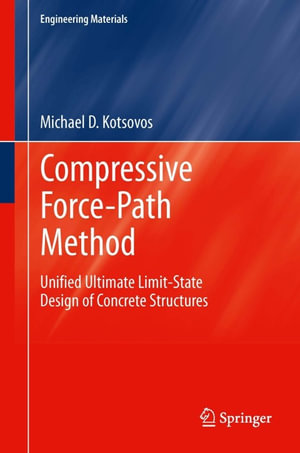
Compressive Force-Path Method : Unified Ultimate Limit-State Design of Concrete Structures - Michael D Kotsovos

Compressive Force-Path Method

Unified Ultimate Limit-State Design of Concrete Structures

By: Michael D Kotsovos

eText | 4 October 2013

At a Glance

eText


$84.99

or 4 interest-free payments of $21.25 with

 or 

Instant online reading in your Booktopia eTextbook Library *

Why choose an eTextbook?

Instant Access *

Purchase and read your book immediately

Read Aloud

Listen and follow along as Bookshelf reads to you

Study Tools

Built-in study tools like highlights and more

* eTextbooks are not downloadable to your eReader or an app and can be accessed via web browsers only. You must be connected to the internet and have no technical issues with your device or browser that could prevent the eTextbook from operating.

This book presents a method which simplifies and unifies the design of reinforced concrete (RC) structures and is applicable to any structural element under both normal and seismic loading conditions. The proposed method has a sound theoretical basis and is expressed in a unified form applicable to all structural members, as well as their connections. It is applied in practice through the use of simple failure criteria derived from first principles without the need for calibration through the use of experimental data. The method is capable of predicting not only load-carrying capacity but also the locations and modes of failure, as well as safeguarding the structural performance code requirements.
In this book, the concepts underlying the method are first presented for the case of simply supported RC beams. The application of the method is progressively extended so as to cover all common structural elements. For each structural element considered, evidence of the validity of the proposed method is presented together with design examples and comparisons with current code specifications. The method has been found to produce design solutions which satisfy the seismic performance requirements of current codes in all cases investigated to date, including structural members such as beams, columns, and walls, beam-to-beam or column-to-column connections, and beam-to-column joints.

on
Desktop
Tablet
Mobile

More in Civil Engineering

Johnstown Flood - David McCullough

eBOOK

$12.99

Performance-Based Building Design - Duncan Winsbury

eBOOK

ICE Core Concepts : Soil Mechanics - Sanjay Kumar Shukla

eBOOK

RRP $94.90

$80.99

15%
OFF