

Get Free Shipping on orders over $0
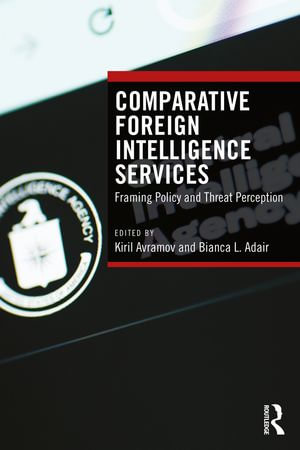
Comparative Foreign Intelligence Services : Framing Policy and Threat Perception - Kiril Avramov

Comparative Foreign Intelligence Services

Framing Policy and Threat Perception

By: Kiril Avramov

eText | 19 October 2026 | Edition Number 1

At a Glance

eText


$87.99

or 4 interest-free payments of $22.00 with

 or 

Instant online reading in your Booktopia eTextbook Library *

Why choose an eTextbook?

Instant Access *

Purchase and read your book immediately

Read Aloud

Listen and follow along as Bookshelf reads to you

Study Tools

Built-in study tools like highlights and more

* eTextbooks are not downloadable to your eReader or an app and can be accessed via web browsers only. You must be connected to the internet and have no technical issues with your device or browser that could prevent the eTextbook from operating.

This edited volume develops a comparative theory of post-Cold War intelligence liaison between the U.S. intelligence community and its international counterparts.

It presents the U.S. perspective on these liaisons and moves beyond simple ally-adversary classifications, showing how cooperation is influenced by strategic threat perception, material power, access to intelligence, and institutional culture. The core of the book rests on a dual framework that combines neoclassical realism and intelligence studies: states pursue liaison not only due to formal alliances or power but also because threat perceptions, institutional culture, and intelligence access interact to create or limit decision advantages. Additionally, the volume advances our understanding of strategic institutional intelligence culture - the patterns through which intelligence agencies influence threat perception, policy interaction, secrecy management, and oversight. It classifies U.S. intelligence relationships along a spectrum: enduring partnerships, wary alliances, and transactional exchanges. The empirical section applies this framework to case studies including British-American and Israeli-American cooperation; Chinese and Russian intelligence under near-peer competition; and Cuban and Iranian systems influenced by regime security, revolutionary ideology, and gray-zone tactics. Examining the nature, type, and quality of interactions with intelligence agencies worldwide, along with an understanding of these interactions, is key to effective and smart intelligence practices.

This book will be of much interest to students of intelligence studies, national security, foreign policy, and international relations, as well as practitioners.

on
Desktop
Tablet
Mobile

Other Editions and Formats

Hardcover

Published: 19th October 2026

More in Warfare & Defence

The Campaigns of Napoleon - David G. Chandler

eBOOK

For the Common Defense - Allan R. Millett

eBOOK

A Question of Loyalty - Douglas C. Waller

eBOOK

RRP $25.99

$22.87

12%
OFF
A Short History of World War I : Short History - James L. Stokesbury

eBOOK

Chain of Command : The Road from 9/11 to Abu Ghraib - Seymour M. Hersh

eBOOK