



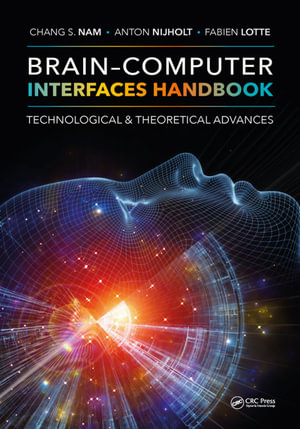
Brain-Computer Interfaces Handbook
Technological and Theoretical Advances
By: Chang S. Nam (Editor), Anton Nijholt (Editor), Fabien Lotte (Editor)
eText | 9 January 2018 | Edition Number 1
At a Glance
eText
$239.80
or
Instant online reading in your Booktopia eTextbook Library *
Why choose an eTextbook?
Instant Access *
Purchase and read your book immediately
Read Aloud
Listen and follow along as Bookshelf reads to you
Study Tools
Built-in study tools like highlights and more
* eTextbooks are not downloadable to your eReader or an app and can be accessed via web browsers only. You must be connected to the internet and have no technical issues with your device or browser that could prevent the eTextbook from operating.
ISBN: 9781351231930
ISBN-10: 1351231936
Published: 9th January 2018
Format: ePUB
Language: English
Publisher: CRC Press
Edition Number: 1
You Can Find This eBook In
Non-FictionComputing & I.T.Computer ScienceHuman-Computer InteractionMedicineNursing & Ancillary ServicesRehabilitationEngineering & TechnologyTechnology in GeneralEngineering in GeneralEnvironmental ScienceTechnical Design
ErgonomicsElectronics & Communications EngineeringElectronics EngineeringAutomatic Control EngineeringMedicine in GeneralFamily & HealthRelationships & Families: Advice & IssuesIndustry & Industrial StudiesIndustrial Relations, Health & SafetyHealth & Safety IssuesArtificial IntelligenceMachine LearningClinical & Internal MedicineNeurology & Clinical Neurophysiology









This product is categorised by
- Non-FictionComputing & I.T.Computer ScienceHuman-Computer Interaction
- Non-FictionMedicineNursing & Ancillary ServicesRehabilitation
- Non-FictionEngineering & TechnologyTechnology in GeneralEngineering in General
- Non-FictionEngineering & TechnologyEnvironmental Science
- Non-FictionEngineering & TechnologyTechnology in GeneralTechnical DesignErgonomics
- Non-FictionEngineering & TechnologyElectronics & Communications EngineeringElectronics EngineeringAutomatic Control Engineering
- Non-FictionMedicineMedicine in General
- Non-FictionFamily & HealthRelationships & Families: Advice & Issues
- Non-FictionIndustry & Industrial StudiesIndustrial Relations, Health & SafetyHealth & Safety Issues
- Non-FictionComputing & I.T.Computer ScienceArtificial IntelligenceMachine Learning
- Non-FictionMedicineClinical & Internal MedicineNeurology & Clinical Neurophysiology