Get Free Shipping on orders over $79
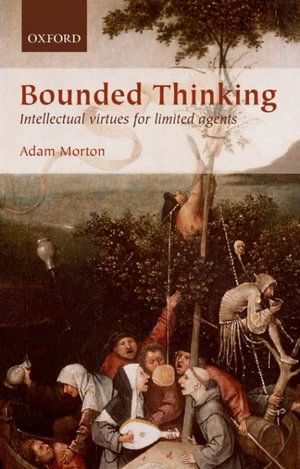
Bounded Thinking : Intellectual virtues for limited agents - Adam Morton

Bounded Thinking

Intellectual virtues for limited agents

By: Adam Morton

eText | 8 November 2012

At a Glance

eText


$98.58

or 4 interest-free payments of $24.64 with

 or 

Instant online reading in your Booktopia eTextbook Library *

Why choose an eTextbook?

Instant Access *

Purchase and read your book immediately

Read Aloud

Listen and follow along as Bookshelf reads to you

Study Tools

Built-in study tools like highlights and more

* eTextbooks are not downloadable to your eReader or an app and can be accessed via web browsers only. You must be connected to the internet and have no technical issues with your device or browser that could prevent the eTextbook from operating.
Bounded Thinking offers a new account of the virtues of limitation management: intellectual virtues of adapting to the fact that we cannot solve many problems that we can easily describe. Adam Morton argues that we do give one another guidance on managing our limitations, but that this has to be in terms of virtues and not of rules, and in terms of success—knowledge and accomplishment—rather than rationality. He establishes a taxonomy of intellectual virtues, which includes 'paradoxical virtues' that sound like vices, such as the virtue of ignoring evidence and the virtue of not thinking too hard. There are also virtues of not planning ahead, in that some forms of such planning require present knowledge of one's future knowledge that is arguably impossible. A person's best response to many problems depends not on the most rationally promising solution to solving them but on the most likely route to success given the profile of intellectual virtues that the person has and lacks. Morton illustrates his argument with discussions of several paradoxes and conundra. He closes the book with a discussion of intelligence and rationality, and argues that both have very limited usefulness in the evaluation of who will make progress on which problems.
on
Desktop
Tablet
Mobile

More in Epistemology & The Theory of Knowledge

Is God a Mathematician? - Mario Livio

eBOOK

The Practical Mind : Skill, Knowledge, and Intelligence - Carlotta Pavese

eBOOK

The Subjective View - William X. Adams

eBOOK

The Basis of Morality - Arthur Schopenhauer

eBOOK

Shifty Epistemology : Elements in Epistemology - Jie Gao

eBOOK

Sense-Data Vindicated : Minding the Gaps in What We See - Mykolas J. Drunga

eBOOK