








Charlotte McConaghy is the author of the international bestseller Migrations, a TIME Magazine Best Book of the Year and the Amazon.com Best Fiction Book of the Year for 2020, which is being translated into over twenty languages and adapted to film. She has both a Graduate Degree in Screenwriting and a Masters Degree in Screen Arts, and lives in Sydney, Australia. Her new novel is called Once There Were Wolves.
Today, Charlotte McConaghy is on the blog to answer a few of our questions about Once There Were Wolves. Read on …

Charlotte McConaghy (Photo by Emma Daniels).
Please tell us about your book, Once There Were Wolves!
CM: Once There Were Wolves is the story of Inti Flynn, a biologist charged with reintroducing wolves into the Scottish Highlands in order to rewild the landscape. Inti is also hoping to heal her twin sister Aggie, damaged by a dark secret the women have fled. Despite assurances the wolves will help the environment thrive, Inti is met with a lot of pushback from locals, who fear for both their agricultural livelihoods and their safety. And when a body turns up, Inti knows her wolves will be blamed, and makes a reckless decision to protect them. Wolves is a love story, a story of family and healing, and a murder mystery, but ultimately it’s about what it takes to rewild not only a landscape, but ourselves, too.
What inspired you to take wolves as the subject of this novel?
CM: They’re just such extraordinary creatures. I first learned about their power when I came across an article about Pando, The Trembling Giant. It’s the world’s oldest and largest living organism, a forest of quaking aspen that isn’t actually a forest, but one tree, connected by a huge underground roots system. Despite having survived what some scientists think might be a million years, Pando is now dying due to human impact. And the perfect way to save it? Wolves.
Wolves are a keystone species that elicit dynamic change, which means they have a trickle-down impact on everything in their environment. In order for a landscape to be biodiverse, it needs apex predators such as wolves, because when wolves hunt the overpopulation of deer, the deer begin to move again, which gives trees and plants a chance to shoot and grow. This also impacts medium and smaller animals, as well as birds and insects and even the flow of water. Which is why we say that wolves have the power to move rivers.
But despite how essential they are, and how shy and frightened of humans, wolves have been feared and hunted to extinction throughout human history. They conjure such intense feeling in people, whether it’s hate or love, and I found this absolutely fascinating.
This is your second novel which deals with conservation and the human impact on biodiversity. Why do you think it’s important to write about these things in fiction?
CM: Climate change and its effects can be really overwhelming. It’s easy to become apathetic in the face of the enormity of the problem. I think a lot of us feel powerless and are searching for ways to have an impact, to make some kind of change, just to do something. For me, what I can do is write books. The arts and literature can wield a great deal of power because they can make a scientific or political issue into an emotional one for readers, which can be the most powerful motivation for action. Scientists and conservationists will be the ones to save us, but they can’t do it alone. They need our help. So in a way it feels like my responsibility, given how passionately I care about these issues, to at least try to connect with people, to energize and galvanise readers to take up the fight.
This is a story of wolves and the fierce woman, Inti, who cares for them. Where did Inti come from and what did you love about writing her as a character?
CM: Inti was a complex creature to write. I knew that because this was going to be a book about empathy, she had to embody that concept, both as someone who was capable of immense empathy and also its absence. She’s been through a trauma that has made her shut off her natural instincts for compassion, and when we meet her she’s living deep in her fury, having seen humans commit too much harm for forgiveness. It sounds strange, but it was such a revelation to be able to write a female character who was driven by rage. It was liberating! And fun! But I also loved writing her journey away from rage into something gentler, something tender, something inspired by the wolves she loves so much. Opening her back up to empathy and vulnerability was a slow but rewarding catharsis.
‘Inti was a complex creature to write. I knew that because this was going to be a book about empathy, she had to embody that concept, both as someone who was capable of immense empathy and also its absence.’
There’s an interesting contrast in the book between the instinctual violence of the wolves and the intentional violence of some of the characters. Was this something you considered when you were writing?
CM: I think human violence tends to be very different from the kind we see in the animal kingdom. For them, it’s survival, and specifically with wolves they in fact spend far more time displaying generosity and tenderness towards each other. They’re driven by unbreakable bonds of family, after all. Whereas humans seem capable of a much crueller kind of violence, one that’s driven not by survival but by selfishness and a lack of empathy. I wanted to explore the idea that rewilding ourselves doesn’t mean losing our sense of community or our responsibilities to each other; in fact the opposite. It’s about rediscovering our capacity for nurturing both nature and each other.
Can you tell us a little bit about your journey towards becoming a writer?
CM: I’ve been writing all my life. As a teenager I loved epic fantasy series, so that’s what I wrote. I had my first book published at 17 and that started me on a path of publishing several YA fantasy and sci-fi books. In about my mid-twenties I realised I really wanted to learn more about the craft of storytelling, so I did two degrees in screenwriting at the Australian Film, Television and Radio School, which taught me so much about things like story structure, genre, character development and theme. I used all I’d learnt to write my first adult literary novel, called Migrations, which was released last year and opened up a different pathway for my writing.
What is the best piece of writing advice you have ever received?
CM: Write the book you want to read. I know this seems obvious but it’s surprising how easy it is to forget when you’re lost in the thick of a project. Writing a book is a long arduous task and if you don’t truly love what you’re writing, if you’re not writing for yourself, for all the things that terrify you and bring you joy, then you’ll never make it to the end. And that love, that passion, will glow through the pages and be felt by readers. Don’t worry about what seems popular at the time or what you think publishers want; be true to your own voice.
What is the last book you read and loved?
CM: I’m currently reading Evie Wyld’s The Bass Rock, and really enjoying it. I also loved Writers and Lovers by Lily King.
What do you hope readers will discover in Once There Were Wolves?
CM: I hope they’ll discover an appreciation for wild creatures and spaces, for the things we haven’t yet lost and how important those things are to this world, and a reawakening of the parts of themselves that come alive when they’re at their wildest.
And finally, what’s up next for you?
CM: I’m currently pregnant, so I’ll be having a baby at around the same time as my book baby gets released into the world. That feels like enough of a challenge, to be honest, but I’ll also be working on my next novel, which is in the early stages but is set on a sub-Antarctic island, and there may be a screenwriting project in the works, too.
Thanks Charlotte!
—Once There Were Wolves by Charlotte McConaghy (Penguin Books Australia) is out now.
McConaghy McConaghy McConaghy
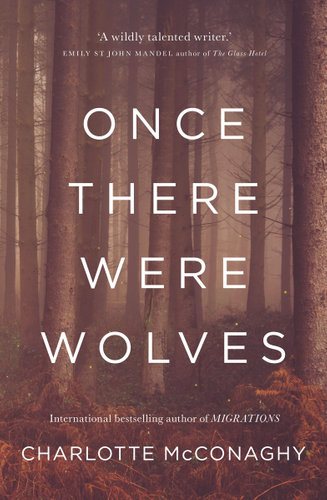
Once There Were Wolves
Limited Signed Copies Available!
Inti Flynn arrives in Scotland with her twin sister, Aggie, to lead a team tasked with reintroducing fourteen grey wolves into the remote Highlands. She hopes to heal not only the dying landscape but a broken Aggie, too. However, Inti is not the woman she once was, and may be in need of rewilding herself.
Despite fierce opposition from the locals, Inti’s wolves surprise everyone by thriving, and she begins to let her guard down, even opening up to the possibility of love. But when a local farmer is found dead, Inti knows where the town will lay blame...

 What do we know about the Boy Swallows Universe Netflix show?
  Booktopia’s top thrilling fiction picks for Crime Month
  Booktopia’s Top First Nations Book Recommendations for 2023
Comments
August 4, 2021 at 2:28 pm
I just ordered a signed copy from an indie bookstore in my country! I’ve been anticipating Once There Were Wolves for months!