Get Free Shipping on orders over $79
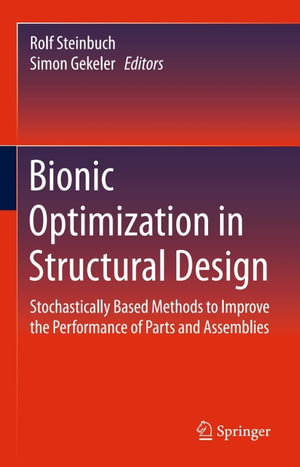
Bionic Optimization in Structural Design : Stochastically Based Methods to Improve the Performance of Parts and Assemblies - Simon Gekeler

Bionic Optimization in Structural Design

Stochastically Based Methods to Improve the Performance of Parts and Assemblies

By: Simon Gekeler (Editor), Rolf Steinbuch (Editor)

eText | 4 November 2015

At a Glance

eText


$129.00

or 4 interest-free payments of $32.25 with

 or 

Instant online reading in your Booktopia eTextbook Library *

Why choose an eTextbook?

Instant Access *

Purchase and read your book immediately

Read Aloud

Listen and follow along as Bookshelf reads to you

Study Tools

Built-in study tools like highlights and more

* eTextbooks are not downloadable to your eReader or an app and can be accessed via web browsers only. You must be connected to the internet and have no technical issues with your device or browser that could prevent the eTextbook from operating.

The book provides suggestions on how to start using bionic optimization methods, including pseudo-code examples of each of the important approaches and outlines of how to improve them. The most efficient methods for accelerating the studies are discussed. These include the selection of size and generations of a study's parameters, modification of these driving parameters, switching to gradient methods when approaching local maxima, and the use of parallel working hardware.

Bionic Optimization means finding the best solution to a problem using methods found in nature. As Evolutionary Strategies and Particle Swarm Optimization seem to be the most important methods for structural optimization, we primarily focus on them. Other methods such as neural nets or ant colonies are more suited to control or process studies, so their basic ideas are outlined in order to motivate readers to start using them.

A set of sample applications shows how Bionic Optimization works in practice. From academic studies on simple frames made of rods to earthquake-resistant buildings, readers follow the lessons learned, difficulties encountered and effective strategies for overcoming them. For the problem of tuned mass dampers, which play an important role in dynamic control, changing the goal and restrictions paves the way for Multi-Objective-Optimization. As most structural designers today use commercial software such as FE-Codes or CAE systems with integrated simulation modules, ways of integrating Bionic Optimization into these software packages are outlined and examples of typical systems and typical optimization approaches are presented.

The closing section focuses on an overview and outlook on reliable and robust as well as on Multi-Objective-Optimization, including

discussions of current and upcoming research topics in the field concerning a unified theory for handling stochastic design processes.

on
Desktop
Tablet
Mobile

More in 3D Graphics & Modelling

MySQL 9 QuickStart Pro - Kylan Fentark

eBOOK