Get Free Shipping on orders over $79
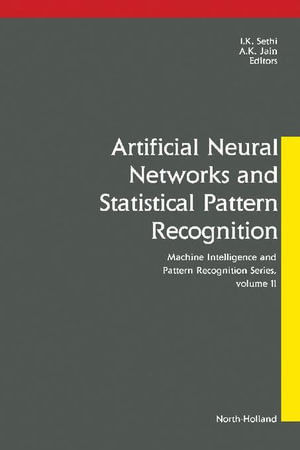
Artificial Neural Networks and Statistical Pattern Recognition : Old and New Connections - I. K. Sethi

Artificial Neural Networks and Statistical Pattern Recognition

Old and New Connections

By: I. K. Sethi (Editor), Anil K Jain (Editor)

eText | 28 June 2014 | Edition Number 1

At a Glance

eText


$89.10

or 4 interest-free payments of $22.27 with

 or 

Instant online reading in your Booktopia eTextbook Library *

Why choose an eTextbook?

Instant Access *

Purchase and read your book immediately

Read Aloud

Listen and follow along as Bookshelf reads to you

Study Tools

Built-in study tools like highlights and more

* eTextbooks are not downloadable to your eReader or an app and can be accessed via web browsers only. You must be connected to the internet and have no technical issues with your device or browser that could prevent the eTextbook from operating.
With the growing complexity of pattern recognition related problems being solved using Artificial Neural Networks, many ANN researchers are grappling with design issues such as the size of the network, the number of training patterns, and performance assessment and bounds. These researchers are continually rediscovering that many learning procedures lack the scaling property; the procedures simply fail, or yield unsatisfactory results when applied to problems of bigger size. Phenomena like these are very familiar to researchers in statistical pattern recognition (SPR), where the curse of dimensionality is a well-known dilemma. Issues related to the training and test sample sizes, feature space dimensionality, and the discriminatory power of different classifier types have all been extensively studied in the SPR literature. It appears however that many ANN researchers looking at pattern recognition problems are not aware of the ties between their field and SPR, and are therefore unable to successfully exploit work that has already been done in SPR. Similarly, many pattern recognition and computer vision researchers do not realize the potential of the ANN approach to solve problems such as feature extraction, segmentation, and object recognition. The present volume is designed as a contribution to the greater interaction between the ANN and SPR research communities.
on
Desktop
Tablet
Mobile

More in Neural Networks & Fuzzy Systems