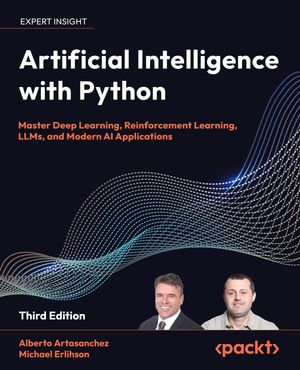
Build AI applications using cutting-edge frameworks like PyTorch, TensorFlow, and Hugging Face Purchase of the print or Kindle book includes a free PDF eBook
Key Features
- Large Language Models (LLMs) like GPT, BERT, and Llama 2 for real-world AI projects
- Advanced AI topics, including MLOps, multimodal AI, and Edge AI deployment
- Hands-on projects in chatbots, autonomous agents, generative AI, and time-series forecasting
Book Description
Artificial Intelligence with Python, Third Edition is a complete, hands-on guide that takes you from the foundations of AI to mastering cutting-edge techniques, including Large Language Models (LLMs), Reinforcement Learning, and MLOps. This fully updated edition ensures you stay ahead with the latest AI innovations. You'll explore machine learning algorithms, neural networks, and state-of-the-art deep learning architectures like transformers and diffusion models. You'll also learn to fine-tune open-source LLMs, work with multimodal AI, and deploy models efficiently using MLOps best practices. Unlike many AI books that focus heavily on theoretical foundations and academic algorithms, this book is designed as a practitioner's guide to mastering AI for real-world applications. Rather than overwhelming you with every algorithm ever created, this book prioritizes the AI techniques that matter most in industry today—from Large Language Models (LLMs) and Reinforcement Learning to MLOps and Edge AI. Whether you're a data scientist, ML engineer, or software developer, this book serves as your hands-on roadmap to building AI-powered applications, fine-tuning models, and deploying AI at scale. By the end of this book, you'll have hands-on experience in building AI-powered applications, deploying models on the cloud and edge devices.
What you will learn
- Implement deep learning with PyTorch and TensorFlow, including CNNs and transformers
- Work with Large Language Models (LLMs) like GPT, BERT, and T5 for NLP tasks
- Build AI-powered chatbots, recommendation systems, and intelligent agents
- Apply AI techniques to real-world domains, including speech recognition and time-series forecasting
- Deploy AI models using FastAPI, Docker, and MLOps tools like MLflow
- Explore Edge AI by running models on Jetson Nano and Raspberry Pi
Who this book is for
This book is for data scientists, AI engineers, machine learning practitioners, and software developers looking to master AI using Python. Basic programming knowledge in Python is recommended, but all AI and machine learning concepts are explained from the ground up, making it accessible to both beginners and experienced professionals.