Get Free Shipping on orders over $79
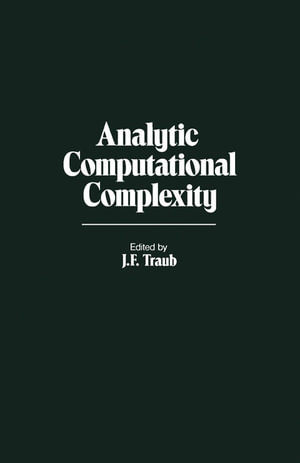
Analytic Computational Complexity - Author

Analytic Computational Complexity

By: Author

eText | 10 May 2014 | Edition Number 1

At a Glance

eText


$89.10

or 4 interest-free payments of $22.27 with

 or 

Instant online reading in your Booktopia eTextbook Library *

Why choose an eTextbook?

Instant Access *

Purchase and read your book immediately

Read Aloud

Listen and follow along as Bookshelf reads to you

Study Tools

Built-in study tools like highlights and more

* eTextbooks are not downloadable to your eReader or an app and can be accessed via web browsers only. You must be connected to the internet and have no technical issues with your device or browser that could prevent the eTextbook from operating.
Analytic Computational Complexity contains the proceedings of the Symposium on Analytic Computational Complexity held by the Computer Science Department, Carnegie-Mellon University, Pittsburgh, Pennsylvania, on April 7-8, 1975. The symposium provided a forum for assessing progress made in analytic computational complexity and covered topics ranging from strict lower and upper bounds on iterative computational complexity to numerical stability of iterations for solution of nonlinear equations and large linear systems.

Comprised of 14 chapters, this book begins with an introduction to analytic computational complexity before turning to proof techniques used in analytic complexity. Subsequent chapters focus on the complexity of obtaining starting points for solving operator equations by Newton's method; maximal order of multipoint iterations using n evaluations; the use of integrals in the solution of nonlinear equations in N dimensions; and the complexity of differential equations. Algebraic constructions in an analytic setting are also discussed, along with the computational complexity of approximation operators.

This monograph will be of interest to students and practitioners in the fields of applied mathematics and computer science.
on
Desktop
Tablet
Mobile

More in Applied Mathematics