Get Free Shipping on orders over $79
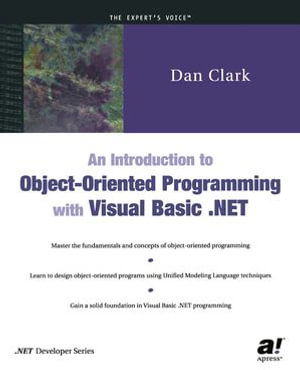
An Introduction to Object-Oriented Programming with Visual Basic .NET - Dan Clark

An Introduction to Object-Oriented Programming with Visual Basic .NET

By: Dan Clark

eText | 1 January 2008

At a Glance

eText


$50.00

or 4 interest-free payments of $12.50 with

 or 

Instant online reading in your Booktopia eTextbook Library *

Why choose an eTextbook?

Instant Access *

Purchase and read your book immediately

Read Aloud

Listen and follow along as Bookshelf reads to you

Study Tools

Built-in study tools like highlights and more

* eTextbooks are not downloadable to your eReader or an app and can be accessed via web browsers only. You must be connected to the internet and have no technical issues with your device or browser that could prevent the eTextbook from operating.

As you work your way through An Introduction to Object-Oriented Programming with Visual Basic .NET, you'll learn how to analyze the business requirements of an application, model the objects and relationships involved in the solution design and, finally, implement the solution using Visual Basic .NET. Along the way you'll also learn the fundamentals of software design, the Unified Modeling Language (UML), object-oriented programming, and Visual Basic .NET.

An Introduction to Object-Oriented Programming with Visual Basic .NET is logically organized into three parts.

  • Part One delves into object-oriented programming methodology and design, concepts that transcend a particular programming language. The concepts presented are important to the success of an object-oriented programming solution regardless of the implementation language chosen. At the conclusion of this part, a case study walks you through the design of a solution based on a real-world scenario.
  • Part Two looks at how object-oriented programming is implemented in Visual Basic .NET. You will explore the structure of classes, class hierarchies, inheritance, and interfaces. The .NET Framework is introduced along with the Visual Studio integrated development environment (IDE).
  • Part Three returns to the case study introduced at the end of Part One. Using the knowledge gained in Part Two, programmers will transform the design into a functional VB .NET application. The application includes a graphical user interface, a business logic class library, and integration with a back-end database.
on
Desktop
Tablet
Mobile

More in Software Engineering

The End of Leadership - Barbara Kellerman

eBOOK

The Ghidra Book, 2nd Edition : The Definitive Guide - Chris Eagle

eBOOK