

Get Free Shipping on orders over $79
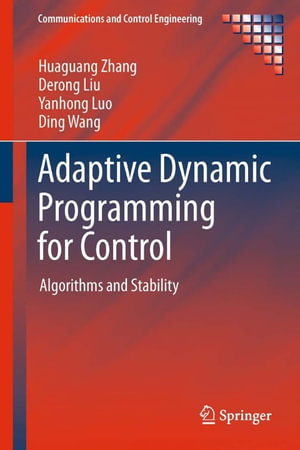
Adaptive Dynamic Programming for Control : Algorithms and Stability - Huaguang Zhang

Adaptive Dynamic Programming for Control

Algorithms and Stability

By: Huaguang Zhang, Derong Liu, Yanhong Luo, Ding Wang

eText | 14 December 2012

At a Glance

eText


$239.00

or 4 interest-free payments of $59.75 with

 or 

Instant online reading in your Booktopia eTextbook Library *

Why choose an eTextbook?

Instant Access *

Purchase and read your book immediately

Read Aloud

Listen and follow along as Bookshelf reads to you

Study Tools

Built-in study tools like highlights and more

* eTextbooks are not downloadable to your eReader or an app and can be accessed via web browsers only. You must be connected to the internet and have no technical issues with your device or browser that could prevent the eTextbook from operating.

There are many methods of stable controller design for nonlinear systems. In seeking to go beyond the minimum requirement of stability, Adaptive Dynamic Programming in Discrete Time approaches the challenging topic of optimal control for nonlinear systems using the tools of adaptive dynamic programming (ADP). The range of systems treated is extensive; affine, switched, singularly perturbed and time-delay nonlinear systems are discussed as are the uses of neural networks and techniques of value and policy iteration. The text features three main aspects of ADP in which the methods proposed for stabilization and for tracking and games benefit from the incorporation of optimal control methods:
• infinite-horizon control for which the difficulty of solving partial differential Hamilton-Jacobi-Bellman equations directly is overcome, and proof provided that the iterative value function updating sequence converges to the infimum of all the value functions obtained by admissible control law sequences;
• finite-horizon control, implemented in discrete-time nonlinear systems showing the reader how to obtain suboptimal control solutions within a fixed number of control steps and with results more easily applied in real systems than those usually gained from infinite-horizon control;
• nonlinear games for which a pair of mixed optimal policies are derived for solving games both when the saddle point does not exist, and, when it does, avoiding the existence conditions of the saddle point.
Non-zero-sum games are studied in the context of a single network scheme in which policies are obtained guaranteeing system stability and minimizing the individual performance function yielding a Nash equilibrium.
In order to make the coverage suitable for the student as well as for the expert reader, Adaptive Dynamic Programming in Discrete Time:
• establishes the fundamental theory involved clearly with each chapter devoted to aclearly identifiable control paradigm;
• demonstrates convergence proofs of the ADP algorithms to deepen understanding of the derivation of stability and convergence with the iterative computational methods used; and
• shows how ADP methods can be put to use both in simulation and in real applications.
This text will be of considerable interest to researchers interested in optimal control and its applications in operations research, applied mathematics computational intelligence and engineering. Graduate students working in control and operations research will also find the ideas presented here to be a source of powerful methods for furthering their study.

on
Desktop
Tablet
Mobile

More in Artificial Intelligence

AI-Powered Search - Trey Grainger

eBOOK

AI : The End of Human Race - Alex Wood

eBOOK

Spring AI in Action - Craig Walls

eBOOK