

1300 187 187
 

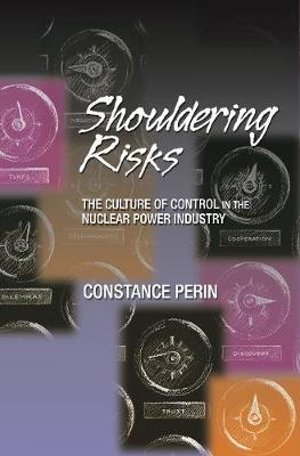
Shouldering Risks

The Culture of Control in the Nuclear Power Industry

Sorry, the book that you are looking for is not available right now.

We did a search for other books with a similar title, and found some results for you that may be helpful.

At the world's some 440 nuclear power plants, experts continually monitor their wide safety margins, and at signs of trouble seek out the sources and recommend changes. Too often for their comfort, and for ours, a subsequent problem reveals that these changes were ineffective or never made. Why this self-defeating pattern? What in this technology's culture of control might undermine experts' best intentions? What kind of problem is it to reduce operating risks?

Following brief highlights of this industry's history over the last twenty years of accidents, near-accidents, and institutional changes, "Shouldering Risks" presents excerpts from interviews with some sixty experts about four relatively recent events at three U.S. plants. Drawing also on her earlier field studies at eleven plants in America and abroad, on industry documents, and others' research, Constance Perin identifies unacknowledged elements in this industry's culture of control; for example, control concepts for reactor design, construction, and regulation carry over to risk handling and event analysis, whose efficacy depends instead on recognizing and interpreting the significance of technical and contextual signals on daily display.

Far more than the sum of its parts, this highly knowledge-dependent technology operates along an axis of meanings, not only along an axis of functions. A culture of control is, like any culture, an intricate system of claims about how to understand the world and act in it. Here, claims pivot around the dynamics of control theory and productivity based on particular assumptions about the relationships of humans to machines, models to reality, certainty to ambiguity, rationality to experience. These four events and accident analyses show that such assumptions can confound control and produce misleading meanings.

"Shouldering Risks" reimagines a broader and deeper culture of control to reshape our understandings of the intellectual capital appropriate to designing, regulating, organizing, and managing this risky enterprise and, perhaps, other such technologies already here or to come.

Constance Perin's study is a penetrating and worrisome analysis... [She] brings flashes of uncommonly graceful language and a sense of empathy for those with whom she spoke, which adds color to the usually bloodless dialects of probabilistic risk assessment... [Perin's study] could result in a crisper recognition of the dilemmas we face ... [while] her conclusions point to serious matters of institutional policy. -- Todd R. La Porte Administrative Science Quarterly [A]n impressive ethnographic study... This book will prove valuable for readers in any discipline who wish to understand more about the functioning of complex systems. -- Charlotte Linde Technology and Culture Perin has written what could be called a manifesto for the second generation of studies involving [high-reliability organizations]... This book is a major, solidly grounded, agenda-setting piece of work held together by an amazing blend of concepts and evidence! -- Karl E. Weick Academy of Management Review Shouldering Risks is an impressive ethnographic study of the nuclear power industry... This book will prove valuable for readers in any discipline who wish to understand more about the functioning of complex systems. -- Charlotte Linde Technology and Culture Constance Perin's study is a penetrating and worrisome analysis of life in several nuclear-powered electricity production stations similar to those on which a number of industrial societies continue to depend... I commend Shouldering Risks ... because Perin's work tries to sort out the logics of control that arise in conducting operations judged by our society to be of such benefit that institutionalizing very hazardous systems seems justified. -- Todd R. La Porte Administrative Science Quarterly

Prefacep. ix
Acknowledgmentsp. xxi
Reading Notesp. xxv
Complexities in Controlp. 1
The Limits of Regulation and Self-Regulationp. 5
The Tradeoff Quandaryp. 9
Concerns, Commitments, and Controlp. 17
The Nuclear Connection: Naval and Corporate Ordersp. 23
The Cycle of Self-Improvement: The Event Review Systemp. 28
Arrow Station: A Leaking Valve in Containmentp. 35
An Account of a Valve Repair Effortp. 35
Event Inquiriesp. 44
The Teams' Reportsp. 48
Insights and Excursionsp. 59
The Parts Templatep. 88
Bowie Station: A Reactor Trip and a Security Lapsep. 98
An Account of an Automatic Reactor/Turbine Tripp. 98
Trip Event Review Team Reportp. 100
Insights and Excursionsp. 103
An Account of a Security Lapsep. 120
Mis-Authorization Event Review Team's Reportp. 123
Insights and Excursionsp. 125
The Two Events: Tangential or Essential?p. 142
Charles Station: Transformer Troublep. 144
An Account of a "Significant Near-Miss" on a Generator Step-up Transformerp. 144
Witnessing "A New Find"p. 151
Team Reportsp. 154
The Reception of the "Organizational Effectiveness" Team Reportp. 158
Insights and Excursionsp. 162
Logics of Controlp. 196
Three Logics of Control Culturep. 198
An Infrastructure of Conundrumsp. 203
Control in Real Timep. 209
Doubt, Discovery, and Interpretationp. 213
Words, Meanings, and Deedsp. 217
Standing in the Way: A System of Claimsp. 224
Crystallizing the Difference: Numbers and Valuesp. 230
Objective and Subjective, Technical and Substantivep. 235
Certainty and Ambiguity, Doubt and Discoveryp. 237
Intellectual Capital for Regulation and Self-Regulationp. 240
Controlling and Coordinating Knowledgep. 242
The Scope of Event Reviewsp. 248
"Maintenance Is Going to Save You"p. 257
"Levels of Maturity"p. 262
Re-Imagining the Culture of Control in the Nuclear Power Industryp. 266
From Functions to Meanings: A Second Axis for Risk-Reductionp. 270
Into the Next Half-Centuryp. 276
Senior Management Group at Overton Stationp. 283
Nuclear Power Plant Modes of Operation or Shutdownp. 286
Study Descriptionp. 288
Notesp. 289
Bibliographyp. 325
Indexp. 367
Table of Contents provided by Publisher. All Rights Reserved.

ISBN: 9780691127774
ISBN-10: 0691127778
Audience: Tertiary; University or College
Format: Paperback
Language: English
Published: 2nd October 2006
Publisher: Princeton University Press
Dimensions (cm): 22.9 x 15.2  x 2.4
Weight (kg): 0.599