Get Free Shipping on orders over $79
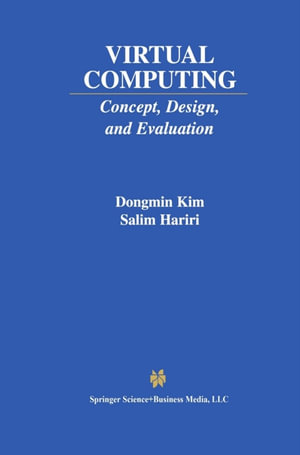
Virtual Computing : Concept, Design, and Evaluation - Dongmin Kim

Virtual Computing

Concept, Design, and Evaluation

By: Dongmin Kim, Salim Hariri

eText | 6 December 2012

At a Glance

eText


$159.01

or 4 interest-free payments of $39.75 with

 or 

Instant online reading in your Booktopia eTextbook Library *

Why choose an eTextbook?

Instant Access *

Purchase and read your book immediately

Read Aloud

Listen and follow along as Bookshelf reads to you

Study Tools

Built-in study tools like highlights and more

* eTextbooks are not downloadable to your eReader or an app and can be accessed via web browsers only. You must be connected to the internet and have no technical issues with your device or browser that could prevent the eTextbook from operating.
The evolution of modern computers began more than 50 years ago and has been driven to a large extend by rapid advances in electronic technology during that period. The first computers ran one application (user) at a time. Without the benefit of operating systems or compilers, the application programmers were responsible for managing all aspects of the hardware. The introduction of compilers allowed programmers to express algorithms in abstract terms without being concerned with the bit level details of their implementation. Time sharing operating systems took computing systems one step further and allowed several users and/or applications to time share the computing services of com­ puters. With the advances of networks and software tools, users and applications were able to time share the logical and physical services that are geographically dispersed across one or more networks. Virtual Computing (VC) concept aims at providing ubiquitous open computing services in analogous way to the services offered by Telephone and Elec­ trical (utility) companies. The VC environment should be dynamically setup to meet the requirements of a single user and/or application. The design and development of a dynamically programmable virtual comput­ ing environments is a challenging research problem. However, the recent advances in processing and network technology and software tools have successfully solved many of the obstacles facing the wide deployment of virtual computing environments as will be outlined next.
on
Desktop
Tablet
Mobile

Other Editions and Formats

Paperback

Published: 13th November 2012

More in Computer Architecture & Logic Design

Quantum Computing - Alex Wood

eBOOK

Think Distributed Systems - Dominik Tornow

eBOOK

File System Forensics - Fergus Toolan

eBOOK