Get Free Shipping on orders over $79
Statistical Image Processing and Multidimensional Modeling - Paul Fieguth

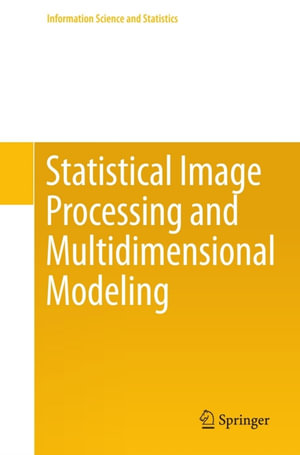
Statistical Image Processing and Multidimensional Modeling

By: Paul Fieguth

eText | 17 October 2010

At a Glance

eText


$239.00

or 4 interest-free payments of $59.75 with

 or 

Instant online reading in your Booktopia eTextbook Library *

Why choose an eTextbook?

Instant Access *

Purchase and read your book immediately

Read Aloud

Listen and follow along as Bookshelf reads to you

Study Tools

Built-in study tools like highlights and more

* eTextbooks are not downloadable to your eReader or an app and can be accessed via web browsers only. You must be connected to the internet and have no technical issues with your device or browser that could prevent the eTextbook from operating.
Images are all around us! The proliferation of low-cost, high-quality imaging devices has led to an explosion in acquired images. When these images are acquired from a microscope, telescope, satellite, or medical imaging device, there is a statistical image processing task: the inference of something—an artery, a road, a DNA marker, an oil spill—from imagery, possibly noisy, blurry, or incomplete. A great many textbooks have been written on image processing. However this book does not so much focus on images, per se, but rather on spatial data sets, with one or more measurements taken over a two or higher dimensional space, and to which standard image-processing algorithms may not apply. There are many important data analysis methods developed in this text for such statistical image problems. Examples abound throughout remote sensing (satellite data mapping, data assimilation, climate-change studies, land use), medical imaging (organ segmentation, anomaly detection), computer vision (image classification, segmentation), and other 2D/3D problems (biological imaging, porous media). The goal, then, of this text is to address methods for solving multidimensional statistical problems. The text strikes a balance between mathematics and theory on the one hand, versus applications and algorithms on the other, by deliberately developing the basic theory (Part I), the mathematical modeling (Part II), and the algorithmic and numerical methods (Part III) of solving a given problem. The particular emphases of the book include inverse problems, multidimensional modeling, random fields, and hierarchical methods.
on
Desktop
Tablet
Mobile

More in Probability & Statistics

Mathematics in Biology - Markus Meister

eBOOK

RRP $194.25

$155.99

20%
OFF
Statistics by Simulation : A Synthetic Data Approach - Carsten F. Dormann

eBOOK

R for Non-Programmers - Daniel Dauber

eBOOK

untitled - TBC ANZ

eBOOK

$31.99