

Get Free Shipping on orders over $79
Python for Natural Language Processing : Programming with NumPy, scikit-learn, Keras, and PyTorch - Pierre M. Nugues

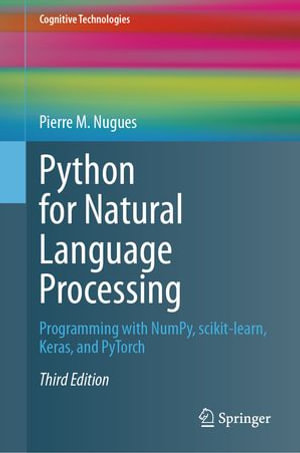
Python for Natural Language Processing

Programming with NumPy, scikit-learn, Keras, and PyTorch

By: Pierre M. Nugues

eText | 9 July 2024 | Edition Number 3

At a Glance

eText


$99.00

or 4 interest-free payments of $24.75 with

 or 

Instant online reading in your Booktopia eTextbook Library *

Why choose an eTextbook?

Instant Access *

Purchase and read your book immediately

Read Aloud

Listen and follow along as Bookshelf reads to you

Study Tools

Built-in study tools like highlights and more

* eTextbooks are not downloadable to your eReader or an app and can be accessed via web browsers only. You must be connected to the internet and have no technical issues with your device or browser that could prevent the eTextbook from operating.

Since the last edition of this book (2014), progress has been astonishing in all areas of Natural Language Processing, with recent achievements in Text Generation that spurred a media interest going beyond the traditional academic circles. Text Processing has meanwhile become a mainstream industrial tool that is used, to various extents, by countless companies. As such, a revision of this book was deemed necessary to catch up with the recent breakthroughs, and the author discusses models and architectures that have been instrumental in the recent progress of Natural Language Processing.

As in the first two editions, the intention is to expose the reader to the theories used in Natural Language Processing, and to programming examples that are essential for a deep understanding of the concepts. Although present in the previous two editions, Machine Learning is now even more pregnant, having replaced many of the earlier techniques to process text. Many new techniques build on the availability of text.

Using Python notebooks, the reader will be able to load small corpora, format text, apply the models through executing pieces of code, gradually discover the theoretical parts by possibly modifying the code or the parameters, and traverse theories and concrete problems through a constant interaction between the user and the machine. The data sizes and hardware requirements are kept to a reasonable minimum so that a user can see instantly, or at least quickly, the results of most experiments on most machines.

The book does not assume a deep knowledge of Python, and an introduction to this language aimed at Text Processing is given in Ch. 2, which will enable the reader to touch all the programming concepts, including NumPy arrays and PyTorch tensors as fundamental structures to represent and process numerical data in Python, or Keras for training Neural Networks to classify texts. Covering topics like Word Segmentation and Part-of-Speech and Sequence Annotation, the textbook also gives an in-depth overview of Transformers (for instance, BERT), Self-Attention and Sequence-to-Sequence Architectures.

on
Desktop
Tablet
Mobile

More in Artificial Intelligence

Medium Hot : Images in the Age of Heat - Hito Steyerl

eBOOK

RRP $22.66

$18.99

16%
OFF
AI Futures - Evgeny Morozov

eBOOK

RRP $16.88

$13.99

17%
OFF
AI-Powered Search - Trey Grainger

eBOOK

HBR Guide to Generative AI for Managers : HBR Guide - Elisa Farri

eBOOK

Where the Axe is Buried - Ray Nayler

eBOOK