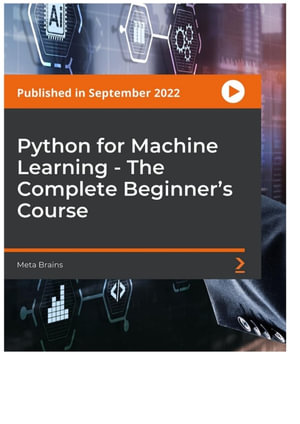
Learn Python programming and Scikit-Learn applied to machine learning regression in this comprehensive guide for beginners
Key Features
- Learn how to use different frameworks in Python to solve real-world problems using deep learning and artificial intelligence (AI)
- Build artificial neural networks with TensorFlow and Keras
- Make predictions using linear regression, polynomial regression, and multivariate regression
Book Description
Machine learning is a branch of computer science in which you can use mathematical input to develop complicated models that fulfil various roles. Python is a popular choice for building machine learning models because of the large number of libraries available. This course will walk you through an astonishing combination of Python and machine learning, teaching you the fundamentals of machine learning so you can construct your own projects.
You'll begin this course by studying Python programming and applying Scikit-Learn to machine learning regression. This lays the groundwork for understanding the theory underpinning simple and multiple linear regression algorithms. Following that, you'll learn how to solve linear and logistic regression issues. The courses further guides you to harness the power of sklearn, grasping the theory and practical application of logistic regression, and then advances to cover the math underpinning decision trees. Finally, you'll learn about the various clustering algorithms.
By the end of this course, you will be able to use these machine learning algorithms in the real world.
What you will learn
- Learn the fundamentals of the deep learning theory
- Explore classification algorithms for K-Nearest Neighbors, decision tree, and logistic regression
- Learn to implement ANN and CNN in Python
- Understand the gradient descent algorithm
- Explore the different types of activation functions
- Explore neural network architecture
Who this book is for
This course is for anyone interested in pursuing a career in machine learning, as well as Python programmers who want to add machine learning skills to their resume. This course will also benefit technologists who want to learn more about how machine learning works in the real world. This course requires familiarity with the fundamentals of Python, as well as readiness, flexibility, a will to learn, and, most importantly, basic mathematical skills.