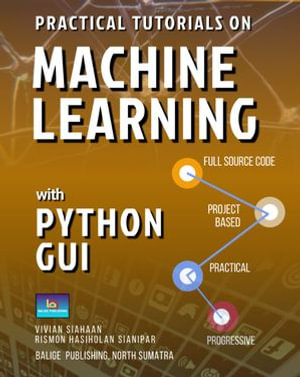
In this book, you will learn how to use NumPy, Pandas, OpenCV, Scikit-Learn and other libraries to how to plot graph and to process digital image. Then, you will learn how to classify features using Perceptron, Adaline, Logistic Regression (LR), Support Vector Machine (SVM), Decision Tree (DT), Random Forest (RF), and K-Nearest Neighbor (KNN) models. You will also learn how to extract features using Principal Component Analysis (PCA), Linear Discriminant Analysis (LDA), Kernel Principal Component Analysis (KPCA) algorithms and use them in machine learning.
In Chapter 1, you will learn: Tutorial Steps To Create A Simple GUI Application, Tutorial Steps to Use Radio Button, Tutorial Steps to Group Radio Buttons, Tutorial Steps to Use CheckBox Widget, Tutorial Steps to Use Two CheckBox Groups, Tutorial Steps to Understand Signals and Slots, Tutorial Steps to Convert Data Types, Tutorial Steps to Use Spin Box Widget, Tutorial Steps to Use ScrollBar and Slider, Tutorial Steps to Use List Widget, Tutorial Steps to Select Multiple List Items in One List Widget and Display It in Another List Widget, Tutorial Steps to Insert Item into List Widget, Tutorial Steps to Use Operations on Widget List, Tutorial Steps to Use Combo Box, Tutorial Steps to Use Calendar Widget and Date Edit, and Tutorial Steps to Use Table Widget.
In Chapter 2, you will learn: Tutorial Steps To Create A Simple Line Graph, Tutorial Steps To Create A Simple Line Graph in Python GUI, Tutorial Steps To Create A Simple Line Graph in Python GUI: Part 2, Tutorial Steps To Create Two or More Graphs in the Same Axis, Tutorial Steps To Create Two Axes in One Canvas, Tutorial Steps To Use Two Widgets, Tutorial Steps To Use Two Widgets, Each of Which Has Two Axes, Tutorial Steps To Use Axes With Certain Opacity Levels, Tutorial Steps To Choose Line Color From Combo Box, Tutorial Steps To Calculate Fast Fourier Transform, Tutorial Steps To Create GUI For FFT, Tutorial Steps To Create GUI For FFT With Some Other Input Signals, Tutorial Steps To Create GUI For Noisy Signal, Tutorial Steps To Create GUI For Noisy Signal Filtering, and Tutorial Steps To Create GUI For Wav Signal Filtering.
In Chapter 3, In this tutorial, you will learn how to use Pandas, NumPy and other libraries to perform simple classification using perceptron and Adaline (adaptive linear neuron). The dataset used is Iris dataset directly from the UCI Machine Learning Repository. You will learn: Tutorial Steps To Implement Perceptron, Tutorial Steps To Implement Perceptron with PyQt, Tutorial Steps To Implement Adaline (ADAptive LInear NEuron), and Tutorial Steps To Implement Adaline with PyQt.
In Chapter 4, you will learn how to use the scikit-learn machine learning library, which provides a wide variety of machine learning algorithms via a user-friendly Python API and to perform classification using perceptron, Adaline (adaptive linear neuron), and other models. The dataset used is Iris dataset directly from the UCI Machine Learning Repository. You will learn: Tutorial Steps To Implement Perceptron Using Scikit-Learn, Tutorial Steps To Implement Perceptron Using Scikit-Learn with PyQt, Tutorial Steps To Implement Logistic Regression Model, Tutorial Steps To Implement Logistic Regression Model with PyQt, Tutorial Steps To Implement Logistic Regression Model Using Scikit-Learn with PyQt, Tutorial Steps To Implement Support Vector Machine (SVM) Using Scikit-Learn, Tutorial Steps To Implement Decision Tree (DT) Using Scikit-Learn, Tutorial Steps To Implement Random Forest (RF) Using Scikit-Learn, and Tutorial Steps To Implement K-Nearest Neighbor (KNN) Using Scikit-Learn.
In Chapter 5, you will learn how to use Pandas, NumPy, Scikit-Learn, and other libraries to implement different approaches for reducing the dimensionality of a dataset using different feature selection techniques. You will learn about three fundamental techniques that will help us to summarize the information content of a dataset by transforming it onto a new feature subspace of lower dimensionality than the original one. Data compression is an important topic in machine learning, and it helps us to store and analyze the increasing amounts of data that are produced and collected in the modern age of technology. You will learn the following topics: Principal Component Analysis (PCA) for unsupervised data compression, Linear Discriminant Analysis (LDA) as a supervised dimensionality reduction technique for maximizing class separability, Nonlinear dimensionality reduction via Kernel Principal Component Analysis (KPCA). You will learn: Tutorial Steps To Implement Principal Component Analysis (PCA), Tutorial Steps To Implement Principal Component Analysis (PCA) Using Scikit-Learn, Tutorial Steps To Implement Principal Component Analysis (PCA) Using Scikit-Learn with PyQt, Tutorial Steps To Implement Linear Discriminant Analysis (LDA), Tutorial Steps To Implement Linear Discriminant Analysis (LDA) with Scikit-Learn, Tutorial Steps To Implement Linear Discriminant Analysis (LDA) Using Scikit-Learn with PyQt, Tutorial Steps To Implement Kernel Principal Component Analysis (KPCA) Using Scikit-Learn, and Tutorial Steps To Implement Kernel Principal Component Analysis (KPCA) Using Scikit-Learn with PyQt.
In Chapter 6, you will learn how to use Keras, Scikit-Learn, Pandas, NumPy and other libraries to perform prediction on handwritten digits using MNIST dataset. You will learn: Tutorial Steps To Load MNIST Dataset, Tutorial Steps To Load MNIST Dataset with PyQt, Tutorial Steps To Implement Perceptron With PCA Feature Extractor on MNIST Dataset Using PyQt, Tutorial Steps To Implement Perceptron With LDA Feature Extractor on MNIST Dataset Using PyQt, Tutorial Steps To Implement Perceptron With KPCA Feature Extractor on MNIST Dataset Using PyQt, Tutorial Steps To Implement Logistic Regression (LR) Model With PCA Feature Extractor on MNIST Dataset Using PyQt, Tutorial Steps To Implement Logistic Regression (LR) Model With LDA Feature Extractor on MNIST Dataset Using PyQt, Tutorial Steps To Implement Logistic Regression (LR) Model With KPCA Feature Extractor on MNIST Dataset Using PyQt, Tutorial Steps To Implement , Tutorial Steps To Implement Support Vector Machine (SVM) Model With LDA Feature Extractor on MNIST Dataset Using PyQt, Tutorial Steps To Implement Support Vector Machine (SVM) Model With KPCA Feature Extractor on MNIST Dataset Using PyQt, Tutorial Steps To Implement Decision Tree (DT) Model With PCA Feature Extractor on MNIST Dataset Using PyQt, Tutorial Steps To Implement Decision Tree (DT) Model With LDA Feature Extractor on MNIST Dataset Using PyQt, Tutorial Steps To Implement Decision Tree (DT) Model With KPCA Feature Extractor on MNIST Dataset Using PyQt, Tutorial Steps To Implement Random Forest (RF) Model With PCA Feature Extractor on MNIST Dataset Using PyQt, Tutorial Steps To Implement Random Forest (RF) Model With LDA Feature Extractor on MNIST Dataset Using PyQt, Tutorial Steps To Implement Random Forest (RF) Model With KPCA Feature Extractor on MNIST Dataset Using PyQt, Tutorial Steps To Implement K-Nearest Neighbor (KNN) Model With PCA Feature Extractor on MNIST Dataset Using PyQt, Tutorial Steps To Implement K-Nearest Neighbor (KNN) Model With LDA Feature Extractor on MNIST Dataset Using PyQt, and Tutorial Steps To Implement K-Nearest Neighbor (KNN) Model With KPCA Feature Extractor on MNIST Dataset Using PyQt.