Get Free Shipping on orders over $79
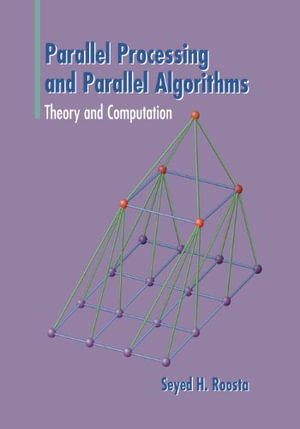
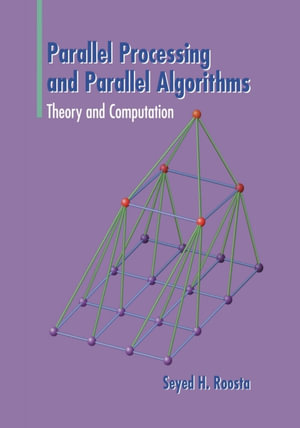
Parallel Processing and Parallel Algorithms : Theory and Computation - Seyed H Roosta

Parallel Processing and Parallel Algorithms

Theory and Computation

By: Seyed H Roosta

eText | 6 December 2012

At a Glance

eText


$159.01

or 4 interest-free payments of $39.75 with

 or 

Instant online reading in your Booktopia eTextbook Library *

Why choose an eTextbook?

Instant Access *

Purchase and read your book immediately

Read Aloud

Listen and follow along as Bookshelf reads to you

Study Tools

Built-in study tools like highlights and more

* eTextbooks are not downloadable to your eReader or an app and can be accessed via web browsers only. You must be connected to the internet and have no technical issues with your device or browser that could prevent the eTextbook from operating.
Motivation It is now possible to build powerful single-processor and multiprocessor systems and use them efficiently for data processing, which has seen an explosive ex­ pansion in many areas of computer science and engineering. One approach to meeting the performance requirements of the applications has been to utilize the most powerful single-processor system that is available. When such a system does not provide the performance requirements, pipelined and parallel process­ ing structures can be employed. The concept of parallel processing is a depar­ ture from sequential processing. In sequential computation one processor is in­ volved and performs one operation at a time. On the other hand, in parallel computation several processors cooperate to solve a problem, which reduces computing time because several operations can be carried out simultaneously. Using several processors that work together on a given computation illustrates a new paradigm in computer problem solving which is completely different from sequential processing. From the practical point of view, this provides sufficient justification to investigate the concept of parallel processing and related issues, such as parallel algorithms. Parallel processing involves utilizing several factors, such as parallel architectures, parallel algorithms, parallel programming lan­ guages and performance analysis, which are strongly interrelated. In general, four steps are involved in performing a computational problem in parallel. The first step is to understand the nature of computations in the specific application domain.
on
Desktop
Tablet
Mobile

Other Editions and Formats

Paperback

Published: 21st October 2012

More in Algorithms & Data Structures

Addiction by Design : Machine Gambling in Las Vegas - Natasha Dow Schüll

eBOOK

Deep Learning Crash Course - Giovanni Volpe

eBOOK

RRP $81.07

$64.99

20%
OFF