Get Free Shipping on orders over $79
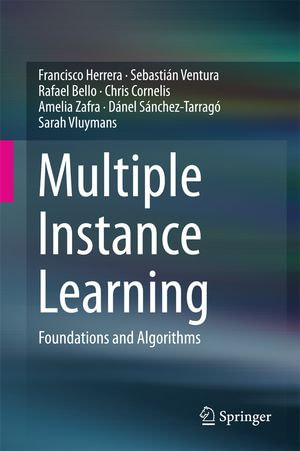
Multiple Instance Learning : Foundations and Algorithms - Francisco Herrera

Multiple Instance Learning

Foundations and Algorithms

By: Francisco Herrera, Sebastián Ventura, Rafael Bello, Chris Cornelis, Sarah Vluymans

eText | 8 November 2016

At a Glance

eText


$189.00

or 4 interest-free payments of $47.25 with

 or 

Instant online reading in your Booktopia eTextbook Library *

Why choose an eTextbook?

Instant Access *

Purchase and read your book immediately

Read Aloud

Listen and follow along as Bookshelf reads to you

Study Tools

Built-in study tools like highlights and more

* eTextbooks are not downloadable to your eReader or an app and can be accessed via web browsers only. You must be connected to the internet and have no technical issues with your device or browser that could prevent the eTextbook from operating.

This book provides a general overview of multiple instance learning (MIL), defining the framework and covering the central paradigms. The authors discuss the most important algorithms for MIL such as classification, regression and clustering. With a focus on classification, a taxonomy is set and the most relevant proposals are specified. Efficient algorithms are developed to discover relevant information when working with uncertainty. Key representative applications are included.

This book carries out a study of the key related fields of distance metrics and alternative hypothesis. Chapters examine new and developing aspects of MIL such as data reduction for multi-instance problems and imbalanced MIL data. Class imbalance for multi-instance problems is defined at the bag level, a type of representation that utilizes ambiguity due to the fact that bag labels are available, but the labels of the individual instances are not defined.

Additionally, multiple instance multiple label learning is explored. This learning framework introduces flexibility and ambiguity in the object representation providing a natural formulation for representing complicated objects. Thus, an object is represented by a bag of instances and is allowed to have associated multiple class labels simultaneously.

This book is suitable for developers and engineers working to apply MIL techniques to solve a variety of real-world problems. It is also useful for researchers or students seeking a thorough overview of MIL literature, methods, and tools.

on
Desktop
Tablet
Mobile

More in Artificial Intelligence

AI-Powered Search - Trey Grainger

eBOOK

AI : The End of Human Race - Alex Wood

eBOOK